Welcome to Geotech!
-1.png)

Portable Magnetic Gradiometer: A Comprehensive Guide to Its Working Principle, Portable Design, and Applications
TIPS:Dive into the portable magnetic gradiometer! This guide explains its working principles, portable design, and uses in geology, archaeology, and environmental monitoring. Unlock the power of magnetic gradient measurement in the field.
I. Introduction: The Power of Measuring Difference
In the world of geophysical prospecting, seeing the subtle details matters. While total field magnetometers are powerful, they can be affected by regional noise and diurnal variations. The solution? Measuring the magnetic gradient. A portable magnetic gradiometer is a sophisticated instrument designed for this exact purpose. This article provides a detailed exploration of this crucial tool. We will dissect its core principle of magnetic gradient measurement. We will examine the innovative engineering behind its field-portable instrument design. Finally, we will showcase its transformative impact across diverse fields, from geology to archaeology.
II. Core Technology: The Differential Magnetometer
At its heart, a gradiometer is a differential magnetometer. Unlike a single sensor that measures the total magnetic field at one point, a gradiometer uses two or more identical magnetometer sensors. These sensors are rigidly fixed a short distance apart (known as the baseline), typically ranging from 0.5 to 1.0 meters.
- The Principle of Operation: The instrument does not measure the absolute magnetic field strength. Instead, it measures the difference in the magnetic field between these two sensors. This difference is the magnetic gradient, which is the rate of change of the magnetic field over distance. The unit of measurement is typically nanotesla per meter (nT/m).
- Key Advantage – Noise Cancellation: This differential-type magnetic sensor configuration offers a monumental advantage: it automatically cancels out uniform magnetic noise. This includes:
- Diurnal Variations: The natural daily fluctuations of the Earth’s magnetic field affect both sensors equally. When the difference is calculated, this common signal is subtracted out.
- Cultural Noise: Distant noise sources from power lines or vehicles also create a field that is nearly uniform across the sensor pair, and is thus eliminated.
This allows the portable magnetic gradiometer to highlight the shallow, localized anomalies caused by small or buried targets, providing a much clearer signal.
III. The Science of Measurement: Magnetic Gradient Measurement
The process of magnetic gradient determination is what gives this instrument its precision. The gradient is a vector, but most portable systems measure the vertical gradient.
The calculation is straightforward:
Vertical Gradient = (B_sensor_bottom – B_sensor_top) / Distance_between_sensors
Where:
B_sensor_bottomis the reading from the lower sensor.B_sensor_topis the reading from the upper sensor.- The distance between sensors is a fixed, known value.
This measurement of magnetic gradient provides a high-resolution map of subsurface magnetic sources. Sharp, high-gradient anomalies typically indicate shallow, small targets, while broad, low-gradient anomalies may suggest deeper or larger sources.
IV. Engineering for the Field: The Portable Design
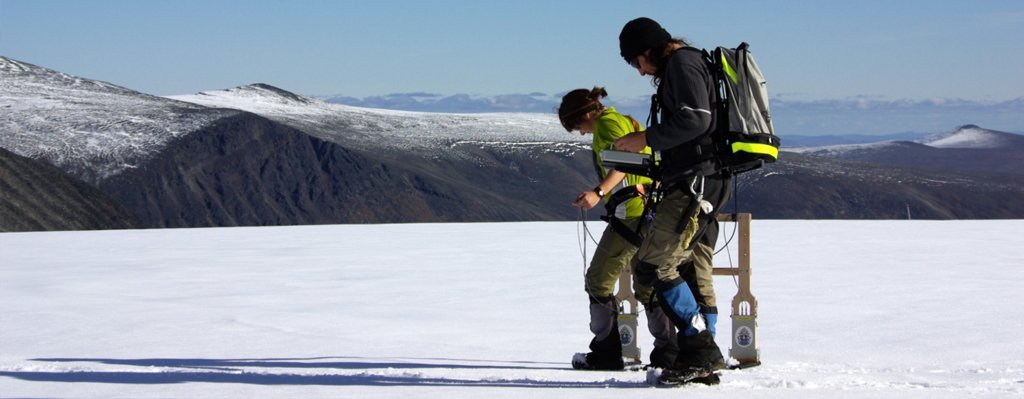
The term field-portable instrument is key to this technology’s success. Modern gradiometers are designed for one purpose: to be carried and operated by a single person in the field with ease.
- Lightweight and Ergonomic: The housing is constructed from lightweight, non-magnetic materials like carbon fiber or aluminum. The design is ergonomic, often worn as a backpack or carried via a harness, minimizing operator fatigue during long survey days.
- Integrated Data Logging and Power: The system is fully integrated. It includes an on-board computer for data logging, a GPS for precise positioning, and a long-lasting battery pack. This eliminates the need for cumbersome external cables and boxes.
- Ruggedness: As a portable field device, it is built to withstand the rigors of the field, including dust, moisture, and minor impacts.
This mobile field instrument design enables rapid deployment and high-density data acquisition over large or difficult-to-access areas.
V. Transforming Exploration: Key Applications
The portable magnetic gradiometer is invaluable across numerous disciplines due to its high resolution and noise rejection.
- Geological Prospecting: Used for detailed mapping of mineralized zones, geological structures, and kimberlite pipes for diamond exploration. Its ability to find small, magnetic minerals is unparalleled.
- Archaeological Geophysics: This is a game-changer for magnetometry archeology. It can detect and map buried walls, ditches, hearths, and pottery kilns with incredible clarity, allowing archaeologists to plan excavations with precision and preserve site integrity.
- Environmental and Engineering Studies: Used to locate buried drums of waste, map landfill boundaries, and in magnetic gradient surveying for unexploded ordnance (UXO) detection. It is also used in pre-construction surveys to locate buried utilities and rebar.
- Security and Defense: Employed as a mobile magnetic radiation device for security screening at checkpoints to detect concealed weapons.
VI. Conclusion: The Essential Tool for High-Resolution Mapping
The portable magnetic gradiometer is more than just a magnetometer; it is a refined tool for seeing the unseen in stunning detail. By focusing on magnetic gradient measurement through its differential magnetometer design, it filters out noise and reveals the magnetic fingerprints of subsurface features. Its evolution into a truly field-portable instrument has democratized high-resolution geophysical surveying, putting powerful discovery capabilities into the hands of geologists, archaeologists, and engineers everywhere. For any project requiring detailed subsurface intelligence, the gradiometer is an indispensable asset.
Reference
- WIKI:https://en.wikipedia.org/wiki/Electrical_resistivity_tomography
- Society of Exploration Geophysicists (SEG) https://seg.org/
- Society of Environmental and Engineering Geophysicists (EEGS) https://www.eegs.org/
- Geology and Equipment Branch of China Mining Association http://www.chinamining.org.cn/
- International Union of Geological Sciences (IUGS) http://www.iugs.org/
- European Geological Survey Union (Eurogeosurveys) https://www.eurogeosurveys.org/
