Welcome to Geotech!
-1.png)


Knowledge base

Exploring High‑Precision Magnetic Field Meters: Applications of Proton Magnetometers
From the early 20th century to the present, magnetometers have undergone remarkable evolution—from simple mechanical devices to highly sophisticated instruments based on advanced physics and electronics. Today, the three most widely used high‑precision magnetometers are the Proton Magnetometer, the Optically…
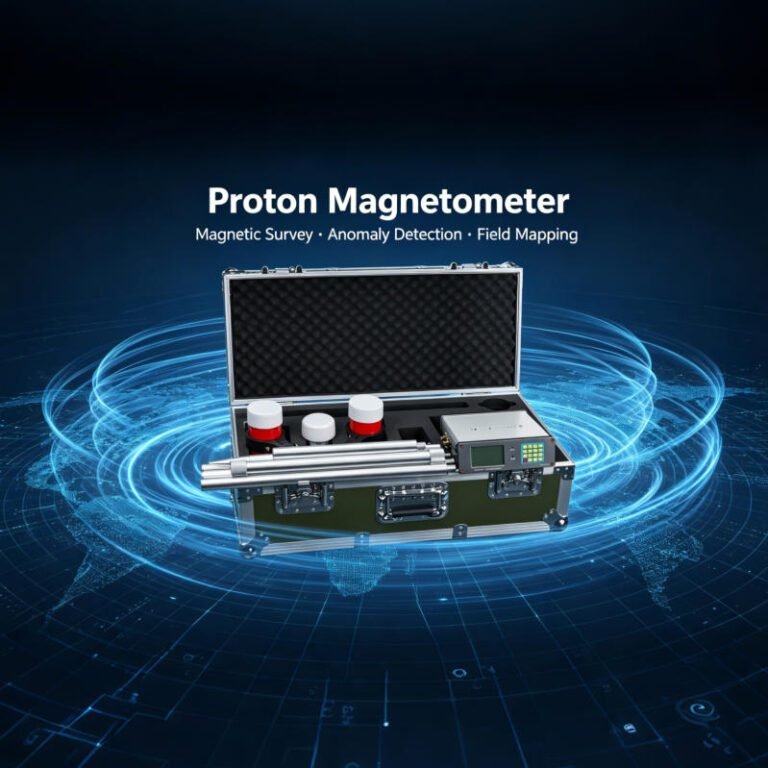
What is a Proton Magnetometer?
Introduction A Proton Magnetometer is a sophisticated geophysical instrument used to measure variations in the Earth’s magnetic field with high precision. It is widely used in mineral exploration, archaeological surveys, environmental monitoring, and engineering applications. This article explores the definition,…
Proton Magnetometer Sensitivity: Is 0.05 nT Necessary for Geological Prospecting?
Overview:A 0.05 nT proton magnetometer can provide high measurement sensitivity for detecting subtle magnetic-field variations, but 0.05 nT is not a universal requirement for every geological survey. The appropriate specification depends on the expected magnetic anomaly, background noise, survey spacing,…
Traditional Magnetometers vs. Proton Magnetometers: Why is 0.05nT Sensitivity Crucial for Geological Prospecting?
I. Introduction Magnetometers have long been an indispensable tool in geophysical exploration, used extensively in mineral exploration, archaeological surveys, underground pipeline detection, and environmental monitoring. As exploration targets become increasingly complex, the demand for instruments with high sensitivity and data…
How Does a Proton Magnetometer Work? From Proton Polarization to Magnetic Field Measurement
Overview:A Proton Magnetometer measures Earth’s total magnetic field by converting proton precession into a measurable frequency. The Proton Magnetometer Working Principle begins with proton polarization in a hydrogen-rich sensor, followed by free precession after the polarizing field is removed. The…