Welcome to Geotech!
-1.png)


Why High-Precision Exploration Equipment Requires Isolation Transformers
Geophysical Instrument Power Supply: Why High-Precision Exploration Equipment Requires Isolation TransformersIntroduction: Periodic noise interference in Magnetotelluric (MT) data acquisition? Signal distortion in seismic geophones complicating profile interpretation? These seemingly complex technical issues often stem from an overlooked factor—power quality. This article delves into the stringent power supply requirements of geophysical instruments and reveals the critical role of isolation transformers in precision exploration.
I. The “Power-Sensitive Nature” of Geophysical Instruments
Modern geophysical instruments are precision electronic devices with extremely high electromagnetic compatibility (EMC) requirements. Taking the Magnetotelluric (MT) method as an example, MTU systems need to detect natural electromagnetic field signals as low as 0.0001Hz in frequency and microvolt level in amplitude—sensitivity comparable to professional radio astronomy equipment.
Measured Impact of Power Quality on Data Acquisition:
| Power Interference Type | Typical Manifestation | Impact on Data Quality |
|---|---|---|
| Voltage Harmonic Distortion | Waveform distortion, high-frequency spikes | False anomalies in spectral analysis masking true geological responses |
| Common-Mode Interference | Signal baseline drift | Systematic shift in apparent resistivity curves, increased interpretation errors |
| Ground Loop Current | 50Hz power frequency interference | Entire survey segment data scrapped, requiring re-acquisition |
| Surge Impacts | Random spike pulses | Triggering false anomalies, increasing geological interpretation ambiguity |
In a 2023 commercial geophysical project in a basin in northwest China, using standard voltage regulators instead of isolation transformers resulted in a 15dB decrease in MT data signal-to-noise ratio across the entire work area, increasing post-processing costs by 40% and delaying the project by two weeks.
II. Three Sources and Propagation Paths of Grid Pollution
The power environment for field exploration operations is far more complex than laboratory conditions. Grid pollution primarily invades precision instruments through three pathways:
1. Conducted Emission
The voltage output from diesel generator sets is not an ideal sine wave but contains substantial harmonic components. Measurements show that standard diesel generators produce output voltage total harmonic distortion (THD) of 8%-15%, far exceeding the <3% requirement for geophysical instruments. These harmonics conduct directly through power lines to instrument front-ends, aliasing into valid signals.
2. Radiated Emission
High-frequency electromagnetic radiation from variable frequency motors, inverter welders, and similar equipment couples into sensors and signal cables through space. In electromagnetic exploration, this interference is particularly fatal—sensors themselves are detecting weak electromagnetic signals, making external radiation a direct noise source.
3. Ground Loop Interference
When multiple devices are grounded through different paths, ground potential differences create circulating currents. A typical scenario: the MTU main unit connects to the camp grounding network while sensors are buried at a distance, creating potential differences between the two locations. 50Hz power frequency current flows through shielding layers forming loops, manifesting as stubborn power frequency interference in signals.
III. Working Principle and Electromagnetic Barrier Function of Isolation Transformers
Isolation transformers achieve energy transfer through magnetic coupling, with complete electrical isolation between primary and secondary windings, making them the core device for blocking the aforementioned interferences.
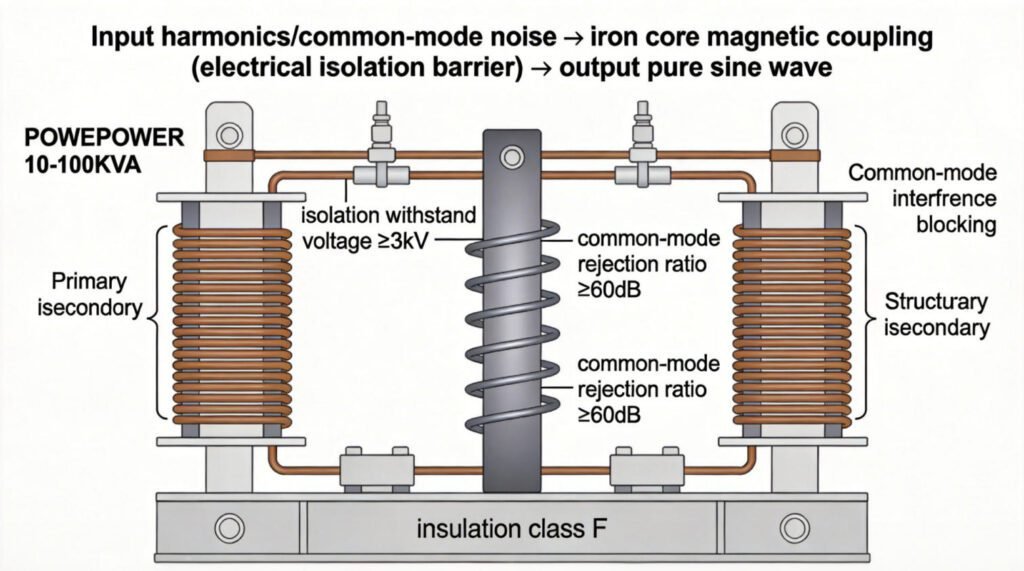
Core Technical Specifications Analysis:
| Parameter | Technical Meaning | Geophysical Application Value |
|---|---|---|
| Electrical Isolation Strength | Primary/secondary withstand voltage ≥3kV | Blocks high-voltage surges, protecting backend precision instruments |
| Common-Mode Rejection Ratio (CMRR) | ≥60dB @ 50Hz-1MHz | Effectively suppresses ground loop power frequency interference |
| Winding Shielding Layer | Copper foil electrostatic shielding | Blocks capacitive coupling of high-frequency radiated interference |
| Insulation Class | Class F (155℃) / Class H (180℃) | Adapts to field wide-temperature environments, long-term stable operation |
| Impedance Matching | Low leakage flux design | Reduces impact on surrounding magnetically sensitive equipment |
In geophysical operations with extremely high electromagnetic compatibility requirements, the selection of dry-type isolation transformers directly determines data acquisition quality. BKPOWER’s dry-type isolation transformer series developed specifically for the geophysical industry utilizes Vacuum Pressure Impregnation (VPI) technology and sectional cylindrical winding structures, achieving CMRR above 65dB. These have been successfully applied to MT, CSAMT, TEM, and other electromagnetic exploration projects.
IV. Dry-Type vs. Oil-Immersed Isolation Transformers: Field Scenario Comparison
In field power systems, transformer type selection must comprehensively consider safety, maintainability, and environmental adaptability.
| Comparison Dimension | Dry-Type Isolation Transformer | Oil-Immersed Transformer |
|---|---|---|
| Fire Safety | Oil-free medium, Class F insulation, self-extinguishing flame retardant | Mineral oil flammable, requires fire protection facilities |
| Environmental Adaptability | -20°C to 50°C wide temperature, moisture and dust resistant | Difficult cold start, requires oil leak prevention |
| Transportation & Installation | 30%-50% lighter weight, no lifting foundation required | Heavy weight, requires concrete foundation |
| Maintenance Requirements | Maintenance-free, only periodic dust removal required | Requires regular oil chromatography analysis, oil replenishment |
| Environmental Compliance | No oil pollution risk, meets ecological protection zone requirements | Soil/water source pollution risk |
| Initial Cost | 15%-20% higher | Lower |
| 10-Year TCO | 25%-30% lower (maintenance-free + no environmental risk) | Higher (maintenance + potential environmental penalties) |
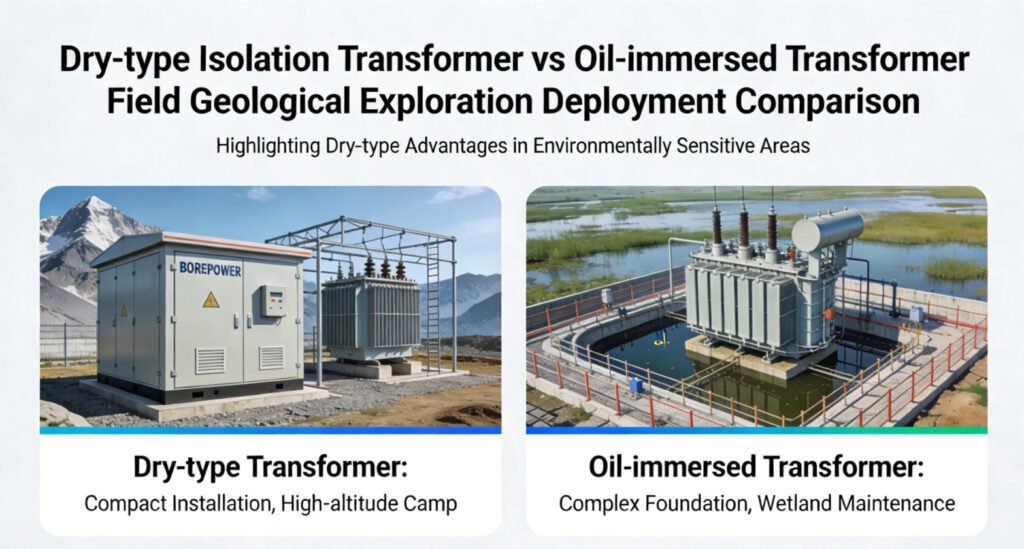
For environmentally sensitive areas such as ecological protection zones, water sources, and farmland, the oil-free characteristic of dry-type transformers makes them the only compliant choice. In a 2024 Yangtze River source area geophysical project, located in the buffer zone of Sanjiangyuan National Park, oil-immersed equipment was explicitly prohibited, making dry-type isolation transformers standard configuration.
V. Supporting Power Supply System Architecture Design
A complete geophysical instrument power supply system should adopt a “three-stage purification” architecture:
Stage 1: Coarse Purification (Generation End)
- Diesel generator or PV storage system
- Output voltage: 380V/220V, frequency 50Hz±2.5%
- Main issues: High harmonic content, frequency drift
Stage 2: Fine Purification (Isolation Transformation)
- Dry-type isolation transformer (capacity selected at 1.2-1.5x load)
- Turns ratio: 1:1 (isolation type) or adjusted according to voltage requirements
- Functions: Electrical isolation, common-mode suppression, voltage stabilization
Stage 3: Terminal Protection (UPS Buffer)
- Online UPS, capacity selected at 2x peak power
- Functions: Zero-transfer backup, precision voltage regulation, battery runtime
For geophysical equipment cluster power supply in the 10-100KVA range, dry-type autotransformers can serve as a cost-effective alternative. Compared to isolation transformers, autotransformers utilize a structure with both electromagnetic coupling and electrical connection, reducing volume by 40% and cost by 30% at the same capacity. These are suitable for scenarios with slightly lower isolation requirements such as seismic exploration and gravity exploration. BKPOWER’s dry-type autotransformer products support flexible 220V/380V conversion, particularly suitable for lightweight requirements of vehicle-mounted mobile geophysical systems.
VI. Typical Application Scenarios and Selection Recommendations
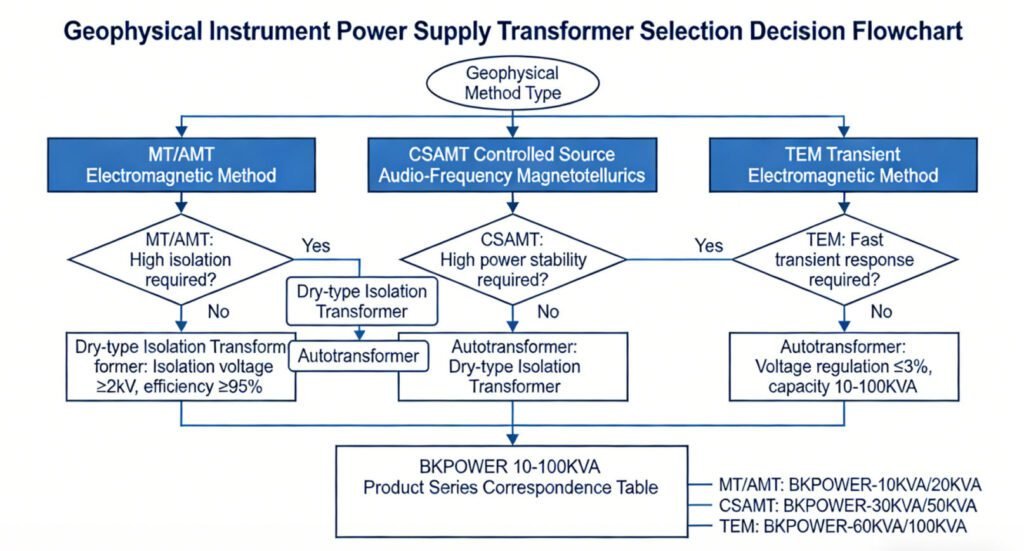
Scenario 1: Magnetotelluric Method (MT/AMT)
- Core Requirement: Extremely high EMC performance, blocking ground loop interference
- Recommended Configuration: Dry-type isolation transformer + online UPS
- Key Parameters: CMRR≥60dB, shielding layer grounding resistance <1Ω
Scenario 2: Controlled Source Audio-frequency Magnetotellurics (CSAMT)
- Core Requirement: Isolation between high-power transmitter and receiver
- Recommended Configuration: Autotransformer at transmitter end (reduced voltage start) + isolation transformer at receiver end
- Key Parameters: Transmitter capacity 50-100KVA, receiver capacity 10-30KVA
Scenario 3: Transient Electromagnetic Method (TEM)
- Core Requirement: Voltage spike suppression during fast turn-off
- Recommended Configuration: Isolation transformer + Surge Protective Device (SPD)
- Key Parameters: Isolation transformer withstand voltage ≥4kV, response time <25ns
VII. Conclusion
The quality of geophysical data begins with power purity. As the core device of electromagnetic compatibility barriers, the selection and configuration of isolation transformers directly affects the reliability of exploration results. In complex field environments, dry-type isolation transformers are gradually becoming standard configuration for high-precision geophysical operations due to their safety, environmental friendliness, and maintenance-free characteristics.
Addressing the special requirements of the geophysical industry, BKPOWER offers a complete range of dry-type isolation transformers and autotransformers from 10KVA to 100KVA, covering Class F/H insulation, IP20/IP54 protection, standard/wide-temperature types, and other specifications. All products are CE certified, support -20°C to 50°C wide-temperature operation, and can be customized with special voltage ratios and interface configurations according to project requirements. To learn more about geophysical-specific power solutions, please visit the BKPOWER official website.
This technical article was jointly prepared by the Geotech geological exploration equipment team and BKPOWER power experts, based on practical application experience in MT, CSAMT, TEM, and other electromagnetic exploration methods.
