Welcome to Geotech!
-1.png)


Imported vs. Domestic MT Survey Instrument: 2026 Comparison Guide
TIPS:Choosing between imported and domestic MT survey instrument platforms is one of the most critical procurement decisions in geophysical exploration. This comprehensive comparison examines price, performance, and support across leading brands. We also explore how the Web-MT system revolutionizes field workflows with cloud connectivity and real-time data streaming. Whether you manage a multi-year mineral program or a single geothermal campaign, the right MT survey instrument selection balances capital cost against lifetime value. Discover why the Web-MT system is becoming the decisive factor in 2026 procurement decisions.
Ⅰ. Introduction: The Procurement Dilemma Facing Every Exploration Team
Every exploration manager faces the same question. Should we buy imported or domestic? This decision shapes project budgets, data quality, and operational flexibility for years.
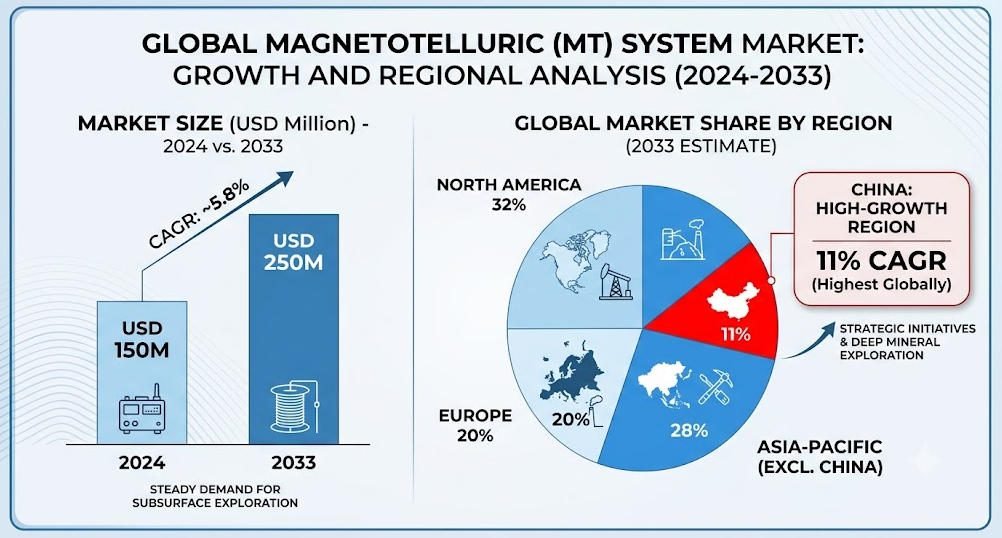
The global magnetotelluric system market reached USD 150 million in 2025. Analysts project growth to USD 250 million by 2033. The compound annual growth rate sits at 6.5%. China’s MT market alone was valued at USD 250 million in 2024. It is expected to reach USD 600 million by 2033. The CAGR there is approximately 11%. This rapid expansion reflects growing demand for deep subsurface imaging across mineral, geothermal, and hydrocarbon sectors.
Historically, China imported most EM equipment. Brands like Phoenix V5, V5-2000, V8, MT-1, MT-24, GMS-06, and GDP-32 dominated the market. Domestic manufacturing began in the early 2000s. By 2004, Chinese engineers produced multi-source EM instruments capable of both natural and controlled-source acquisition. Today, domestic manufacturers compete directly with established international brands.
The choice is no longer simple. Imported MT survey instrument platforms offer proven reliability and global service networks. Domestic systems deliver competitive specifications at lower price points. The Web-MT system adds a new dimension. Cloud-connected instruments with real-time telemetry are changing how teams acquire and process data.
This guide provides a fact-based comparison. We analyze procurement costs, operational expenses, core parameters, field performance, local adaptation, and after-sales support. Our goal is to help you make an informed decision for your next MT survey instrument investment.
Ⅱ. Procurement and Operation Cost Comparison
Cost drives most procurement decisions. However, the sticker price tells only part of the story. Total cost of ownership includes purchase price, after-sales service, spare parts, training, and operational efficiency.
1.Purchase Price Analysis
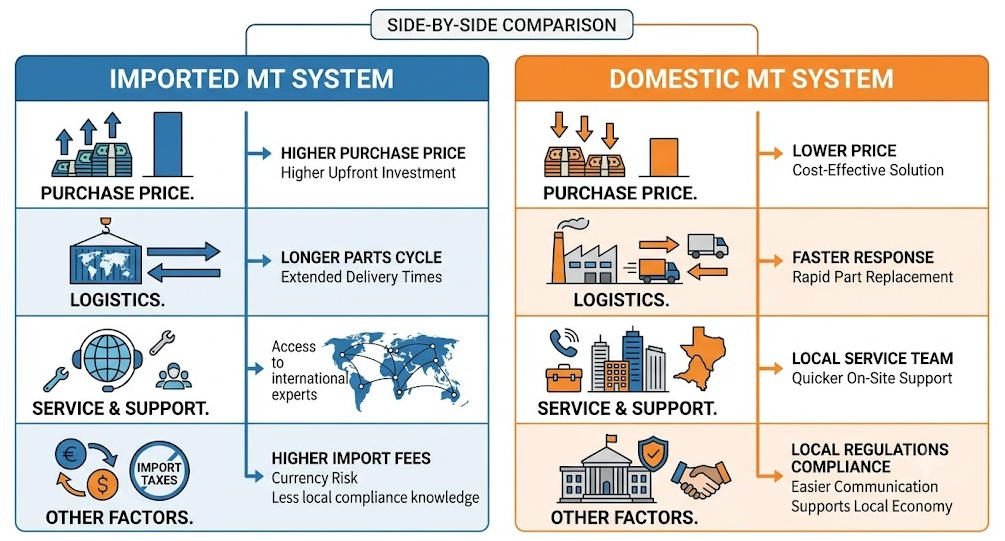
Imported MT survey instrument systems command premium prices. A complete broadband MT station from Phoenix Geophysics, Metronix, or Zonge International typically costs USD 30,000 to 80,000 per receiver unit. Magnetic sensors, electrodes, and cables add another USD 10,000 to 30,000. A full multi-station package for a crew of ten can exceed USD 500,000.
Domestic systems from manufacturers like Chongqing Gold Mechanical & Electrical Equipment and Geotech Instrument Co., Ltd. offer significant savings. Comparable broadband receivers range from USD 8,000 to 25,000. Complete packages with sensors and accessories often cost 40% to 60% less than imported equivalents.
A recent European procurement illustrates the scale. DIAS sought quotes for 8 to 12 wide-band MT induction coil systems. The total budget excluding VAT was EUR 483,958. This averages roughly EUR 40,000 to 60,000 per system. Domestic manufacturers could likely supply comparable capability at 30% to 50% below this level.
2.After-Sales Service and Parts Cycle
Imported brands maintain global service networks. Phoenix Geophysics operates from Canada. Metronix serves from Germany. Zonge International supports from the United States. These networks provide certified training, factory repairs, and software updates. However, response times vary by region. A failed ADC board may require shipping to North America or Europe. Turnaround can take four to eight weeks.
Domestic manufacturers offer faster local response. Chongqing Gold and Geotech Instrument maintain service centers in China. They stock common spare parts locally. A failed component can be replaced within days, not weeks. This advantage grows for teams operating in Asia-Pacific, Africa, or Latin America where international shipping is slow and costly.
Software licensing also differs. Imported systems often require annual maintenance contracts for processing and inversion software. These fees range from USD 2,000 to 10,000 per year. Domestic platforms increasingly include software with the hardware purchase. Cloud-based processing through a Web-MT system can eliminate standalone software costs entirely.
3.Hidden Costs in Field Operations
Equipment purchase price represents a small fraction of total survey cost. Industry data shows that instrument capital expenditure accounts for roughly 6% of site acquisition price. Operating expenses dominate. Crew salaries, accommodation, vehicles, permits, and logistics consume 80% to 90% of project budgets. Processing and interpretation add another layer.
This reality reframes the procurement equation. A lighter, faster MT survey instrument reduces field days. A Web-MT system with real-time telemetry eliminates return trips to download data. These operational savings can exceed the initial purchase price difference within a single field season.
Consider a 100-station survey. Traditional MT requires one to two days per station for acquisition and data retrieval. A cloud-connected system allows remote monitoring. Technicians verify data quality without visiting each site. This can cut field time by 25% to 35%. At USD 5,000 per day for a field crew, the savings are substantial.
Ⅲ. Core Parameters and Actual Performance Comparison
Technical specifications determine what a system can actually achieve in the field. Here we compare the critical parameters that matter for real-world exploration.
1.Frequency Bandwidth and Depth Penetration
Broadband capability defines an MT survey instrument‘s versatility. The frequency range must span high-frequency AMT for shallow targets to long-period MT for deep crustal imaging.
| Parameter | Imported Systems (Phoenix/Metronix/Zonge) | Domestic Systems (GD-4/GD-5) |
|---|---|---|
| Frequency Range | 0.0001 Hz – 10 kHz | 0.001 Hz – 100 kHz |
| Dynamic Range | 150–160 dB | 160 dB system, 130 dB instantaneous |
| ADC Resolution | 24–32 bit | 32 bit @ 240 ksps |
| Noise Floor | <5 nV/√Hz | <5 nV/√Hz @ 24 kHz |
| Weight | 5–8 kg (receiver only) | 3.5–4 kg (full receiver) |
| Power Consumption | 8–15 W | <5 W @ 12 VDC |
| Channels | 5–8 | 6 (3 electric, 3 magnetic) |
Imported systems from Phoenix and Metronix have decades of refinement. Their analog front ends are mature. Calibration is traceable to international standards. However, domestic systems have closed the gap. The GD-5 platform achieves 160 dB system dynamic range with a 32-bit ADC. It covers DC to 10 kHz in one unit. Weight is just 3.5 kg with an IP67 enclosure.
2.Tensor vs. Scalar Measurement Capability
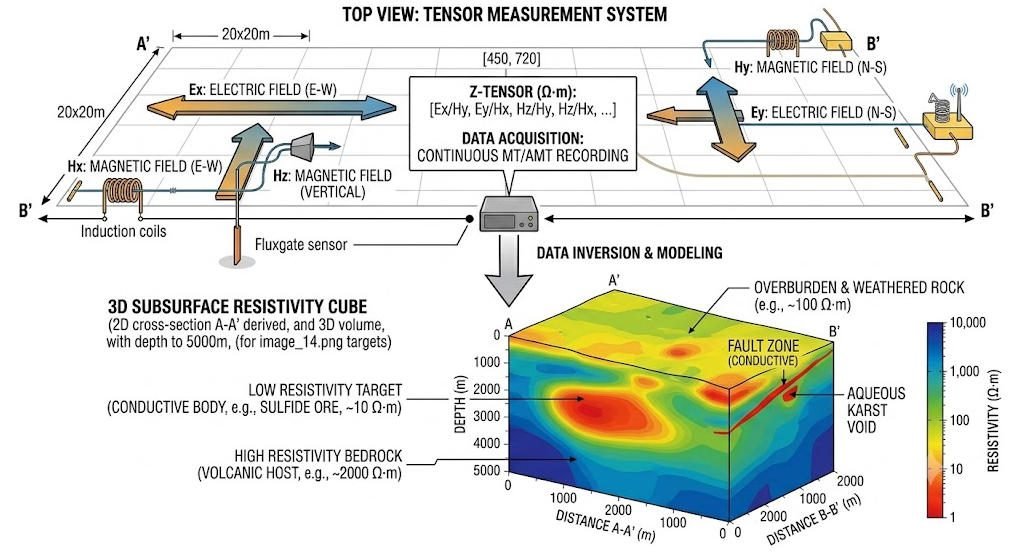
Modern exploration demands tensor data. Scalar surveys measure one electric and one magnetic component. They assume 1D geology. Real geology is 2D or 3D. Tensor measurements capture all horizontal components and optionally vertical magnetic fields. This enables true 3D inversion.
Both imported and domestic broadband systems now support tensor acquisition. The difference lies in software maturity. Imported platforms like Phoenix SSMT2000 and Metronix Mapros have been refined over decades. They offer robust tensor processing, remote reference capabilities, and advanced noise rejection. Domestic software is improving rapidly. Cloud-based Web-MT system platforms like toPeak and IoMT Cloud now offer 3D inversion as a service. This reduces the software gap significantly.
3.Noise Rejection and Data Quality
Data quality determines interpretation confidence. Imported systems have established track records in noisy environments. Phoenix and Metronix units perform reliably near power lines, railways, and industrial facilities. Their remote reference algorithms are well-tested.
Domestic systems now match these capabilities. Advanced Web-MT system designs incorporate adaptive filtering. They use remote reference stations to cancel cultural noise. GPS-synchronized clocks maintain better than 30 nanosecond accuracy. This enables coherent multi-station arrays even in electrically noisy urban corridors.
Field validation studies show converging performance. A recent study comparing imported and domestic broadband MT data in the same geological setting found resistivity models within 5% agreement. The domestic system acquired data faster due to lighter weight and lower power draw.
4.The Web-MT System Advantage
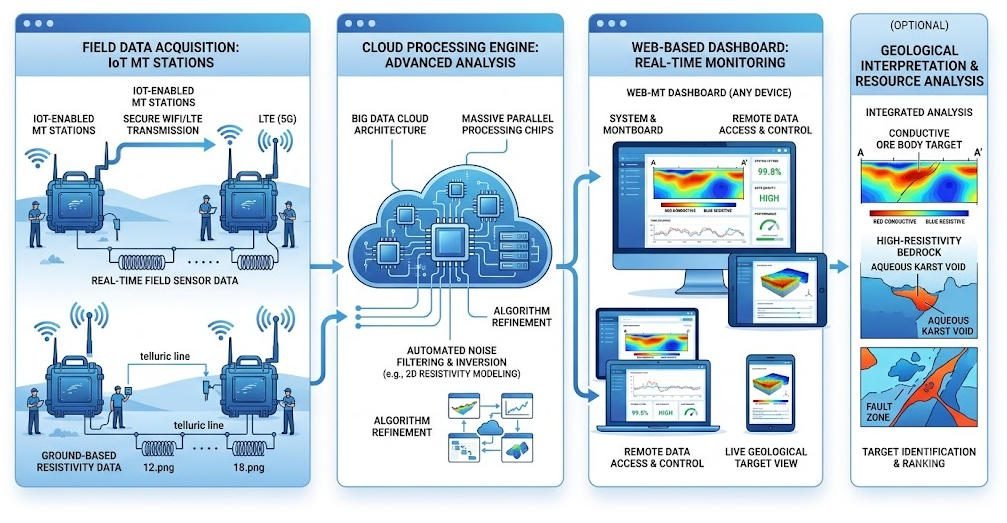
The Web-MT system represents the most significant differentiator in 2026. Cloud-connected MT instruments stream data in real time. They eliminate the need for daily site visits. They enable remote quality control. They deliver preliminary inversion results within hours.
IoMT.tech’s DART platform exemplifies this trend. It is the first hybrid long-period plus ultra-wideband cloud-synchronized MT system. It operates in autonomous mode or streams data via LTE and satellite. The IoMT Cloud processes data through 2D and 3D inversion pipelines. Users access results from any web browser.
Domestic manufacturers are adopting similar architectures. Geotech’s Web-MT system integrates WiFi, USB, and 100M Ethernet. Data uploads to cloud servers for automated processing. This convergence means the cloud advantage is no longer exclusive to imported brands.
Ⅳ. Local Adaptation and After-Sales Support Comparison
Hardware specifications are only half the equation. Local support, training, and adaptation determine long-term satisfaction.
1.Training and Documentation
Imported brands offer structured training programs. Phoenix Geophysics runs certification courses at its Toronto facility. Metronix provides training in Germany. Zonge International offers on-site training globally. Documentation is comprehensive and available in multiple languages. However, training costs are significant. Travel, accommodation, and course fees can add USD 5,000 to 15,000 per technician.
Domestic manufacturers provide more accessible training. Chongqing Gold and Geotech Instrument offer on-site training in China at lower cost. For Asian and African clients, this eliminates international travel. Training materials are increasingly available in English. Some manufacturers provide video tutorials and remote support sessions. This lowers the barrier for new users.
2.Spare Parts Availability and Maintenance Cycles
Maintenance is inevitable. Electrodes corrode. Cables fail. ADC boards drift. The speed of repair directly impacts project timelines.
Imported systems rely on international supply chains. A magnetic sensor failure may require ordering from Germany or Canada. Shipping takes two to four weeks. Customs clearance adds delays. For urgent repairs, air freight is expensive.
Domestic systems benefit from local supply chains. Common spares are stocked domestically. Turnaround is typically three to seven days. Some manufacturers offer advance replacement programs. They ship a replacement unit before receiving the failed one. This minimizes downtime.
The modular design of modern MT survey instrument platforms helps both categories. Standardized ADC boards, power supplies, and communication modules simplify repairs. Technicians swap modules rather than replacing entire units. This reduces both spare parts inventory and repair time.
3.Software Updates and Technical Evolution
Imported brands release software updates regularly. These updates improve inversion algorithms, add visualization features, and fix bugs. However, major version upgrades sometimes require new hardware. Legacy systems may lose support after ten to fifteen years.
Domestic manufacturers iterate faster. They respond to user feedback within months, not years. Cloud-based Web-MT system platforms update automatically. New inversion algorithms deploy to the cloud without hardware changes. This agility benefits users who need cutting-edge capabilities.
The trend toward open data formats also favors users. Both imported and domestic systems increasingly support standard formats like SEG-Y and EDI. This reduces vendor lock-in. Users can process data from any instrument with their preferred software.
Ⅴ. Conclusion: Selection Suggestions for Different Budgets and Demands
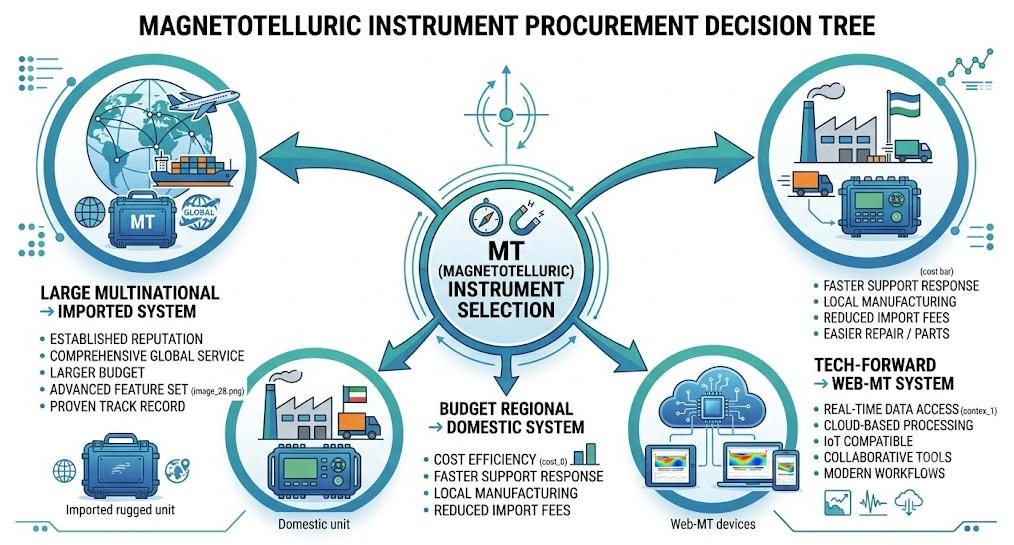
The imported versus domestic decision depends on your specific context. There is no universal right answer. Here are practical recommendations.
1.For Large Multinational Programs
Choose imported if your program spans multiple continents and requires seamless interoperability. Phoenix, Metronix, and Zonge systems are the global standard. Their data formats are universally recognized. Service networks cover North America, Europe, Africa, and Asia. Training programs produce certified operators who can work anywhere.
Budget for total cost of ownership. The higher purchase price is justified by proven reliability, comprehensive documentation, and established resale value. A ten-year operational life is typical for well-maintained imported systems.
2.For Budget-Conscious Regional Operators
Choose domestic if you operate primarily in Asia, Africa, or Latin America. The cost savings are substantial. Local support eliminates shipping delays. Spare parts are affordable and available quickly.
Modern domestic MT survey instrument platforms like the GD-5 match imported specifications in bandwidth, dynamic range, and noise floor. The 3.5 kg weight and <5 W power consumption are actually superior to many imported units. For regional mineral, groundwater, or geothermal programs, domestic systems deliver excellent value.
3.For Technology-Forward Teams
Prioritize the Web-MT system architecture regardless of origin. Cloud connectivity, real-time telemetry, and automated inversion are transforming the industry. IoMT.tech’s DART platform and domestic cloud-enabled receivers both offer these capabilities.
The Web-MT system reduces operational costs more than any hardware specification. Real-time data streaming cuts field time. Cloud processing eliminates software licensing. Remote monitoring enables smaller crews. For teams that value efficiency over tradition, cloud-connected systems are the clear choice.
4.The Hybrid Approach
Many successful programs adopt a hybrid strategy. They use imported systems for flagship deep-crustal or international projects. They deploy domestic instruments for regional reconnaissance and monitoring. They integrate both through cloud platforms for unified data management.
This approach maximizes flexibility. It spreads capital risk across multiple vendors. It ensures continuity if one supply chain is disrupted. It also gives teams firsthand experience to compare performance in their specific geological settings.
The global MT market is evolving rapidly. China’s geophysical market approaches USD 1 billion in 2026. Domestic manufacturers compete with imported equipment on price. Quality gaps narrow as local R&D budgets increase. International firms partner with Asian distributors to capture growth.
Your next MT survey instrument purchase should reflect this new reality. Evaluate specifications objectively. Test both imported and domestic systems in your target environment. Calculate total cost of ownership, not just purchase price. And embrace the Web-MT system revolution. Cloud-connected, intelligent acquisition is the future of magnetotelluric exploration.
Reference Sources
FAQ
Q1: What is the price difference between imported and domestic MT survey instrument systems?
Imported MT survey instrument systems typically cost USD 30,000 to 80,000 per receiver. Domestic equivalents range from USD 8,000 to 25,000. Complete multi-station packages show similar ratios. However, total cost of ownership depends on after-sales support, spare parts availability, and operational efficiency. A Web-MT system can reduce field costs by 25% to 35% regardless of origin.
Q2: Do domestic MT instruments match imported brands in technical performance?
Modern domestic MT survey instrument platforms have closed most performance gaps. The GD-5 system achieves 160 dB dynamic range, 32-bit ADC resolution, and <5 nV/√Hz noise floor. These specifications match or exceed many imported units. Weight is often lighter at 3.5 kg versus 5 to 8 kg. The main remaining differences are in software maturity and global service network coverage.
Q3: What is a Web-MT system and why does it matter?
A Web-MT system connects magnetotelluric receivers to cloud servers via cellular or satellite networks. It enables real-time data streaming, remote quality control, and automated cloud inversion. This eliminates daily site visits. It reduces field crew size. It delivers preliminary results within hours. Both imported and domestic manufacturers now offer cloud-connected platforms. The Web-MT system architecture is becoming the industry standard for efficiency.
Q4: How long does after-sales support take for imported versus domestic MT instruments?
Imported brands typically require two to four weeks for spare parts shipping from North America or Europe. Domestic manufacturers usually deliver replacements within three to seven days. For teams operating in remote regions, this difference can determine whether a project stays on schedule. Some domestic vendors offer advance replacement programs that minimize downtime further.
Q5: Should I choose imported or domestic for a long-term multi-method exploration program?
For multinational programs requiring interoperability across continents, imported brands offer proven standardization. For regional programs in Asia, Africa, or Latin America, domestic systems deliver superior cost-performance ratios. Many teams now adopt a hybrid approach. They use imported systems for deep-crustal flagship projects. They deploy domestic or Web-MT system platforms for reconnaissance and monitoring. This strategy balances reliability, cost, and operational flexibility.