Welcome to Geotech!
-1.png)

Proton Precession Magnetometer vs Proton Magnetometer
TIPS:In geophysical exploration and archaeological research, Proton Precession Magnetometer (PPM) and Proton Magnetometer represent two distinct technical approaches. This article thoroughly analyzes their operational principles: PPM achieves high-precision absolute measurements (±0.1nT accuracy) by detecting the Larmor precession frequency of protons in Earth’s magnetic field, while broader Proton Magnetometers (e.g., Overhauser-based systems) excel in sensitivity and energy efficiency through dynamic polarization. The comparison covers their applications in mineral exploration, archaeological site detection, and environmental monitoring, highlighting technological convergence trends for optimized fieldwork solutions.
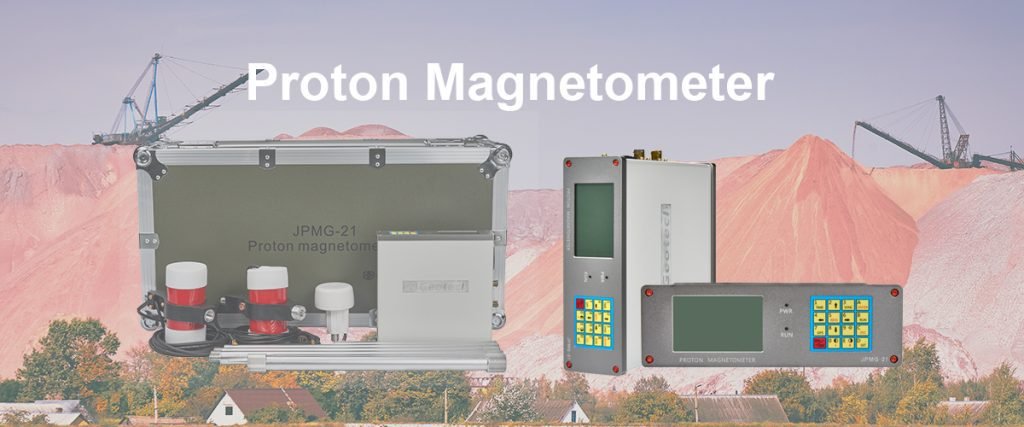
1. Definitions and Core Principles
- Proton Magnetometer (Broad Sense)
Refers to all magnetic field measurement instruments based on Proton Nuclear Magnetic Resonance (NMR) principles. This category includes:- Proton Precession Magnetometer (PPM)
- Overhauser Effect Proton Magnetometer
- ³He Magnetometer
- Proton Precession Magnetometer (PPM)
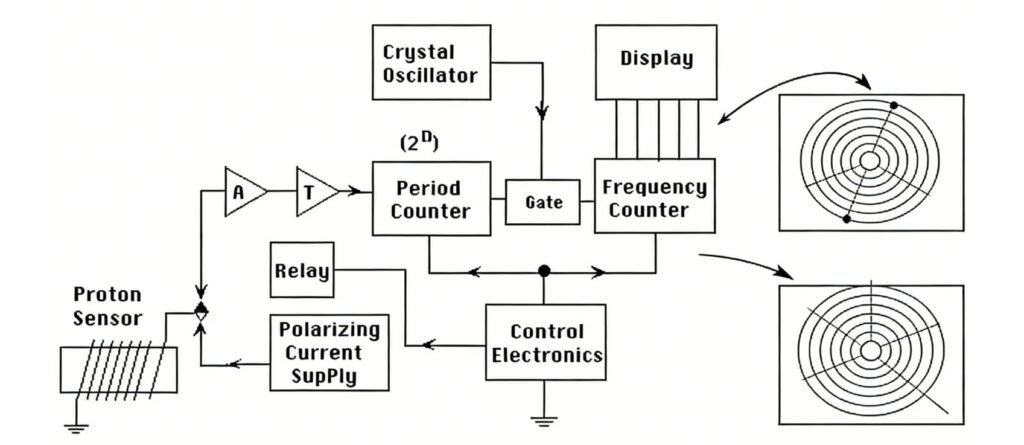
A specific type of proton magnetometer that measures the Larmor precession frequency of protons in a static polarizing magnetic field. Key principles:- Polarization: Strong external magnetic fields (1–2 Tesla) align proton spins in hydrogen-rich liquids (e.g., water, alcohol).
- Free Precession: After removing the polarizing field, protons precess around Earth’s magnetic field (B0) at frequencies proportional to B0 (Formula: f = γp·B0/(2π), where γp = 42.576 MHz/T).
- Signal Detection: Coils capture precession-induced voltage signals, and frequency analysis calculates B0.
2. Technical Specifications Comparison
| Parameter | Proton Precession Magnetometer | General Proton Magnetometer |
|---|---|---|
| Polarization Method | Static polarizing field | Dynamic polarization (e.g., Overhauser effect) or optical pumping |
| Signal Source | Continuous precession signal | Transient signals (dynamic polarization) or resonance signals (optical pumping) |
| Power Consumption | High (requires sustained polarizing current) | Low (dynamic polarization: ~1–3 W) |
| Noise Level | 10−1 nT/Hz@0.1Hz | Dynamic polarization: 10−2 nT/Hz@0.1Hz |
| Application Scope | Ground-based high-precision absolute measurements | Airborne, continuous monitoring |
3. Key Applications
- Geological Exploration
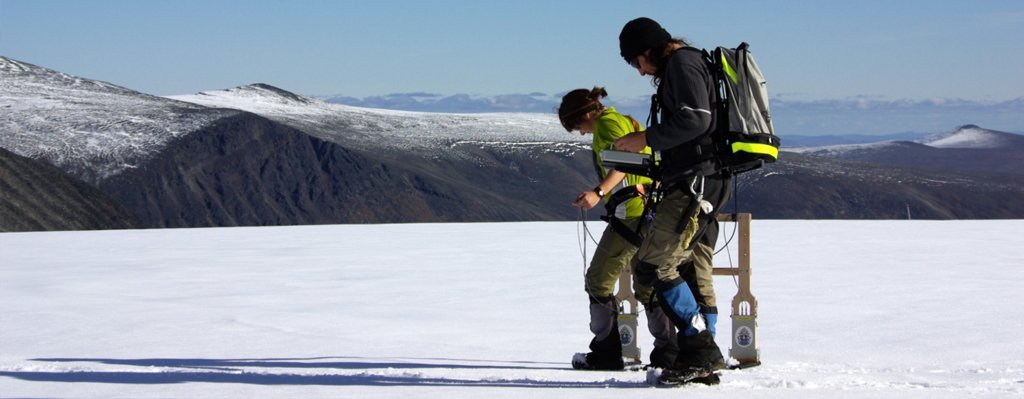
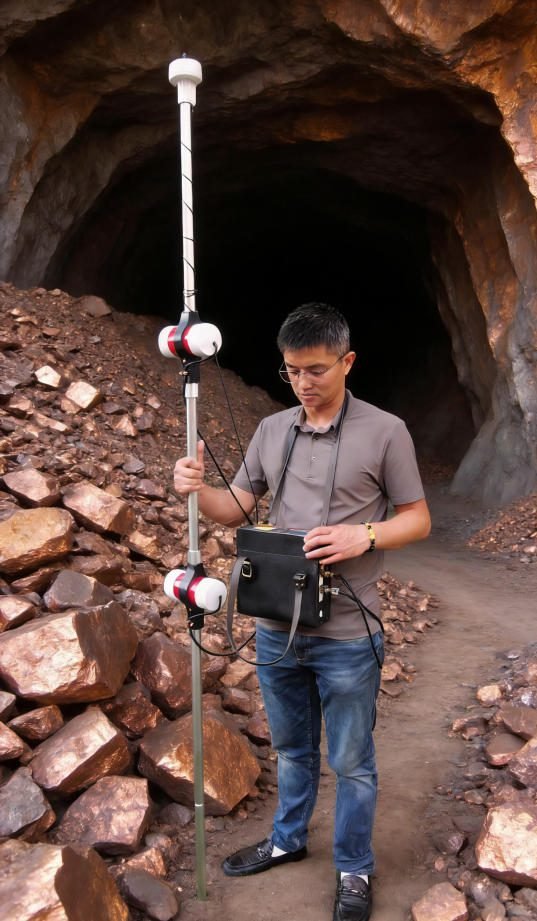
Detecting magnetic anomalies for mineral (iron ore, copper) and hydrocarbon exploration 7. - Archaeological Research
Non-invasive location of ancient artifacts (e.g., bronze, shipwrecks). - Environmental Monitoring
Tracking groundwater contamination, soil pollution, and geohazard precursors. - Military Use
Landmine detection, underground facility localization.
4. Product Examples
- Proton Precession Magnetometers
- GEM GSM-19T: Resolution 0.01 nT, sensitivity 0.1 nT, integrated GPS 4.
- Marine Magnetics SeaSPY: 0.1 nT absolute accuracy, ideal for global magnetic monitoring.
- Dynamic Polarization Proton Magnetometers
- G-882G Optically Pumped Magnetometer: Sensitivity 0.004 nT/√Hz, 20 Hz sampling rate.
- SeaSPY2 Overhauser: 0.01 nT sensitivity, no dead zones, suitable for continuous monitoring.
5. Advantages and Limitations
| Aspect | Proton Precession Magnetometer | General Proton Magnetometer |
|---|---|---|
| Advantages | High absolute accuracy, low drift, robust in harsh environments | High sensitivity, real-time data, low power consumption |
| Limitations | Slow polarization (minutes), limited gradient tolerance | Requires complex calibration, temperature sensitivity |
6. Market Trends
- Technology Integration: Combining PPM with optical pumping for omnidirectional measurements.
- Low Power Optimization: Reducing energy consumption for extended field operations.
- AI Integration: Embedding machine learning algorithms for real-time temperature drift correction.
Summary
Proton Precession Magnetometers (PPMs) excel in high-precision static measurements, while broader proton magnetometer technologies (e.g., Overhauser, optical pumping) prioritize dynamic adaptability. Both play critical roles in geophysics, archaeology, and defense, with ongoing advancements driving their evolution.
Related Articles
| Anchor Text | Target URL | Core Content |
|---|---|---|
| Proton Magnetometer Measurement Principle | https://geotechcn.net/service/how-proton-precession-works-in-measurement/ | Proton precession physics and measurement workflow |
| Proton Magnetometer Working Principle | https://geotechcn.net/service/proton-magnetometer-from-hydrogen-atom-polarization-to-accurate-magnetic-field-measurement/ | Proton polarization and total-field measurement |
| Proton Magnetometer Signal Processing | https://geotechcn.net/service/proton-magnetometer-signal-processing/ | Signal detection, filtering, and frequency estimation |
| Proton Magnetometer Signal Modulation | https://geotechcn.net/service/modulation-of-a-proton-magnetometer-signal-due-to-rotation/ | Rotation-related signal modulation and measurement quality |
| Proton Magnetometer Insights | https://geotechcn.net/service/proton-magnetometer-insights/ | General magnetometer concepts, applications, and equipment selection |
| Single-Sensor Proton Magnetometer | https://geotechcn.net/products/magnetic-instrument/proton-magnetometer-single/ | Single-sensor product configuration |
| Dual-Sensor Proton Magnetometer | https://geotechcn.net/products/magnetic-instrument/dual-sensor-proton-magnetometer/ | Dual-sensor measurement and gradient applications |
| Magnetic Instruments | https://geotechcn.net/products/magnetic-instrument/ | Magnetic exploration instrument portfolio |
Reference Sources
| Organization / Source | Reference URL | Core Content |
|---|---|---|
| U.S. Geological Survey (USGS) — Introduction to Geomagnetism | https://www.usgs.gov/programs/geomagnetism/introduction-geomagnetism | Total magnetic field intensity and geomagnetic measurement |
| U.S. Geological Survey (USGS) — Instrumentation | https://www.usgs.gov/programs/geomagnetism/science/instrumentation | Proton magnetometers and fluxgate magnetometers in observatories |
| Society of Exploration Geophysicists (SEG) | https://seg.org/ | Geophysical exploration methods and professional resources |
| European Association of Geoscientists and Engineers (EAGE) | https://www.eage.org/ | Geoscience and engineering research resources |
| National Institute of Standards and Technology (NIST) | https://www.nist.gov/ | Measurement science and physical constants |
FAQ
Q1. What is a Proton Precession Magnetometer?
A Proton Precession Magnetometer is a scalar magnetic field instrument that measures total magnetic field intensity by detecting the precession frequency of hydrogen protons. It is used in geological mapping, mineral exploration, archaeological investigations, and selected geomagnetic surveys where total-field measurements are required.
Q2.How does a Proton Precession Magnetometer work?
A PPM polarizes hydrogen protons using a temporary magnetic field. After the field is removed, the protons precess around the ambient magnetic field and generate a weak electrical signal. The instrument estimates the precession frequency and converts it into total magnetic field intensity using the proton gyromagnetic ratio.
Q3. What is the difference between a Proton Precession Magnetometer and an Overhauser Magnetometer?
A conventional PPM uses a temporary magnetic field to polarize protons and detects their free precession. An Overhauser Magnetometer uses dynamic nuclear polarization to enhance proton polarization. Both measure total magnetic field intensity, but their signal generation, power requirements, and measurement cycles differ.
Q4. What is the difference between a Proton Precession Magnetometer and a fluxgate magnetometer?
A PPM measures total magnetic field intensity as a scalar value. A fluxgate magnetometer measures magnetic field components along its sensor axes. PPMs are used for total-field surveys, while fluxgate instruments provide directional information and can support continuous vector measurements.
Q5. What should I consider when choosing a Proton Precession Magnetometer?
Important factors include sensitivity, resolution, accuracy, measurement cycle, dynamic range, gradient tolerance, environmental protection, and data output. Survey objectives, magnetic interference, required sampling rate, sensor configuration, and data processing requirements should also be evaluated.