Welcome to Geotech!


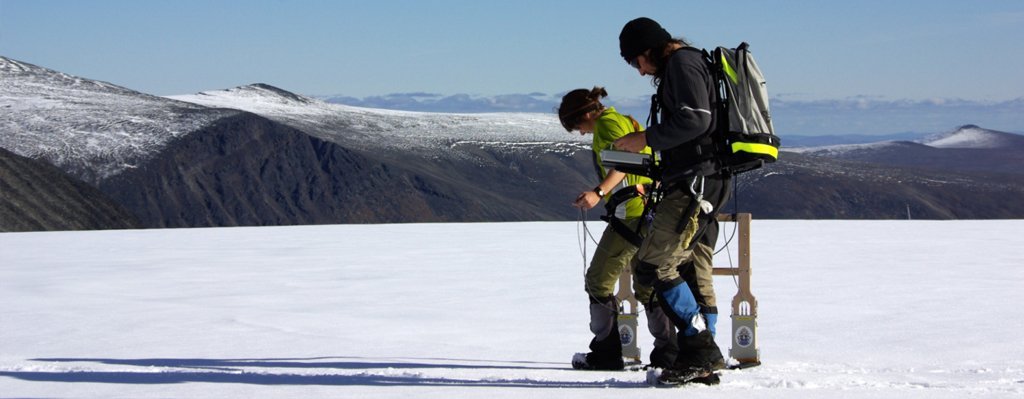
What is 2D/3D ERT Surveys? 2D vs 3D ERT: Principle, Comparison & Applications
Overview:2D electrical resistivity tomography delivers rapid cross-sectional subsurface imaging for linear survey corridors. 3D electrical resistivity tomography provides volumetric resistivity models for complex geological targets. This guide compares 2D electrical resistivity tomography and 3D electrical resistivity tomography across resolution, cost, deployment and field applications.
Ⅰ. Definition and Fundamental Principle
1. Core Definition of ERT
Electrical Resistivity Tomography (ERT) is a near-surface geophysical method that maps subsurface electrical resistivity variations by injecting controlled DC currents into the ground and measuring resulting potential differences. It reconstructs 2D or 3D resistivity models that reflect lithology, fluid content, porosity and geological structures.
ERT relies on the contrast between conductive and resistive subsurface materials. Clay-rich soils, saline groundwater and metallic ores typically show low resistivity, while bedrock, fresh water and voids exhibit high resistivity. This property makes ERT applicable across engineering, environmental and mineral exploration projects.
2. Basic Physical Principle
When DC current is injected into the ground through two current electrodes, it creates an electric field within the subsurface. The shape and intensity of this field depend on the spatial distribution of electrical resistivity in the geological media.
Potential electrodes placed at the surface measure voltage drops caused by the current flow. Apparent resistivity is calculated using Ohm’s law adjusted by a geometric factor specific to the electrode array. Inversion algorithms then convert apparent resistivity values into true resistivity cross-sections or volumes.
Modern multi-channel ERT systems acquire hundreds of data points per measurement cycle, enabling high-density imaging with sub-meter resolution. This represents a major advance over traditional resistivity sounding methods.
Ⅱ. 2D ERT: Technology and Deployment
1. Technical Principle
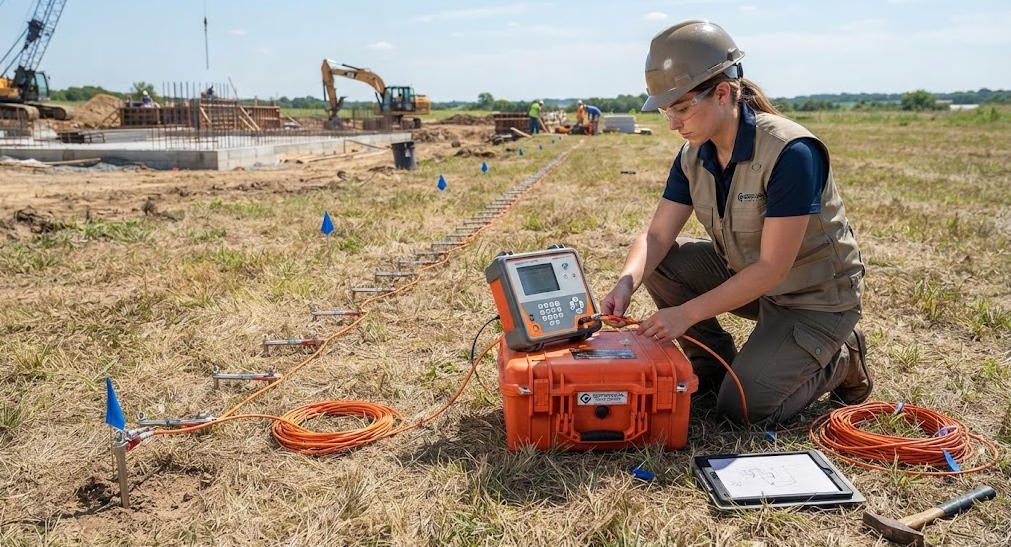
2D ERT uses a linear array of electrodes laid out along a straight survey line. Each measurement cycle activates different pairs of current and potential electrodes to sample resistivity at varying depths and horizontal positions along the line.
The method produces a vertical cross-sectional (2D) image of subsurface resistivity beneath the survey line. Depth of investigation increases with total array length, typically reaching approximately 20–25% of the total electrode spread length.
Roll-along acquisition is a standard efficiency technique for 2D ERT. After completing one array length, the crew moves the rear section of electrodes to the front of the line, extending the profile continuously without full re-deployment.
2. Typical Configurations and Arrays
2D ERT supports multiple electrode array configurations, each with distinct resolution and depth characteristics.
表格
| Array Type | Resolution Profile | Depth Penetration | Best Application |
|---|---|---|---|
| Wenner | Strong vertical resolution, weaker horizontal detail | Moderate | Layered geology, groundwater surveys |
| Schlumberger | Good depth penetration, moderate resolution | Good | Deep bedrock mapping, regional surveys |
| Dipole-Dipole | Excellent horizontal resolution, weaker deep signal | Moderate | Lateral features, faults, cavities |
| Pole-Pole | Fast acquisition, broad coverage | Limited | Reconnaissance surveys, large area screening |
Most modern 2D ERT systems support programmable mixed arrays. Survey designers select configurations based on target geometry, expected depth and site noise conditions.
3. Field Deployment and Productivity
A standard 2D ERT crew of 3–4 technicians can deploy 2–5 km of profile per day, depending on terrain and electrode spacing. Typical electrode spacing ranges from 1 m for shallow high-resolution surveys to 10–20 m for deep regional investigations.
Field workflow follows a consistent sequence: line layout, electrode planting, cable connection, system test, data acquisition, and line roll-over. Real-time quality monitoring ensures data integrity before moving to the next segment.
2D ERT is particularly cost-effective for linear projects such as pipeline routes, tunnel alignments and levee inspections. It provides continuous subsurface coverage along the entire feature length.
Ⅲ. 3D ERT: Technology and Deployment
1. Technical Principle
3D ERT extends the resistivity method into three dimensions by deploying electrodes in a 2D grid pattern. Current and potential electrode pairs are activated across the entire grid, sampling resistivity in all horizontal directions as well as with depth.
The result is a volumetric resistivity model that can be sliced in any orientation: cross-section, plan view or arbitrary oblique section. This enables accurate localization of complex 3D geological features such as karst caves, sinkholes and fault zones.
3D ERT resolves features that would be missed or misinterpreted by 2D profiles alone. It eliminates the assumption that geology is uniform perpendicular to the survey line.
2. Grid Design and Sampling
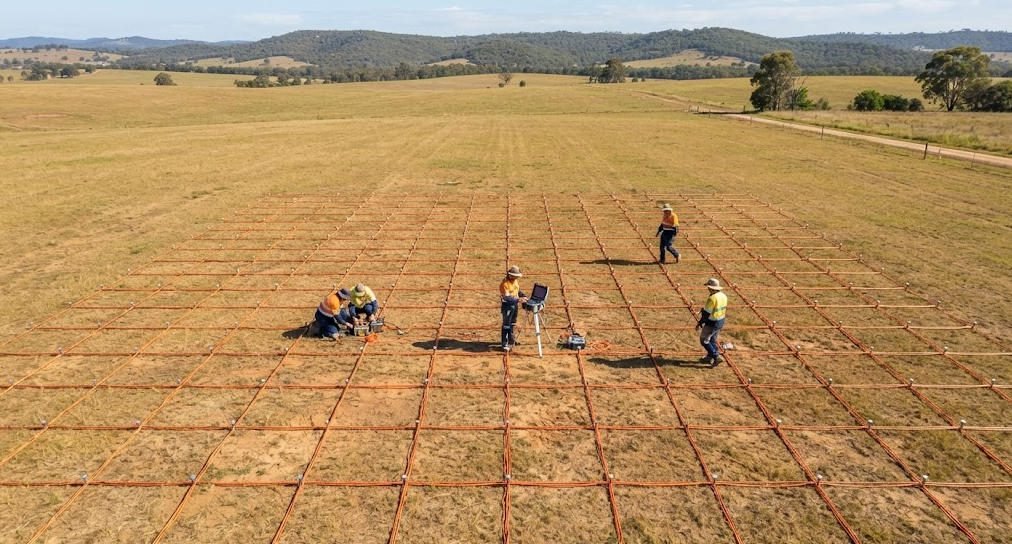
3D ERT grids are designed based on target size, depth and required resolution. Typical grid spacing ranges from 2 m to 10 m, with grid sizes from 10×10 electrodes for small sites up to 64×64 or larger for regional investigations.
Rectangular grids are most common, but irregular grids can be adapted to site boundaries and access constraints. Multi-directional current injection improves data coverage and reduces inversion artifacts.
Data density in 3D surveys is significantly higher than in 2D. A 30×30 electrode grid produces thousands of data points per measurement cycle, requiring more powerful acquisition hardware and longer processing times.
3. Field Deployment and Productivity
3D ERT requires larger field crews (typically 5–7 technicians) and longer deployment times. A crew can cover approximately 0.5–1 km² per day with standard electrode spacing, depending on terrain complexity and grid density.
Automated cable deployment systems and multi-channel parallel acquisition have improved 3D ERT productivity significantly in recent years. Even so, 3D surveys remain substantially more expensive per unit area than 2D profiling.
3D ERT is typically deployed for targeted investigations of anomalous zones identified by preliminary 2D surveys. This staged approach optimizes both cost and investigation effectiveness.
Ⅳ. 2D vs 3D ERT: Comparative Analysis
1. Technical and Economic Comparison
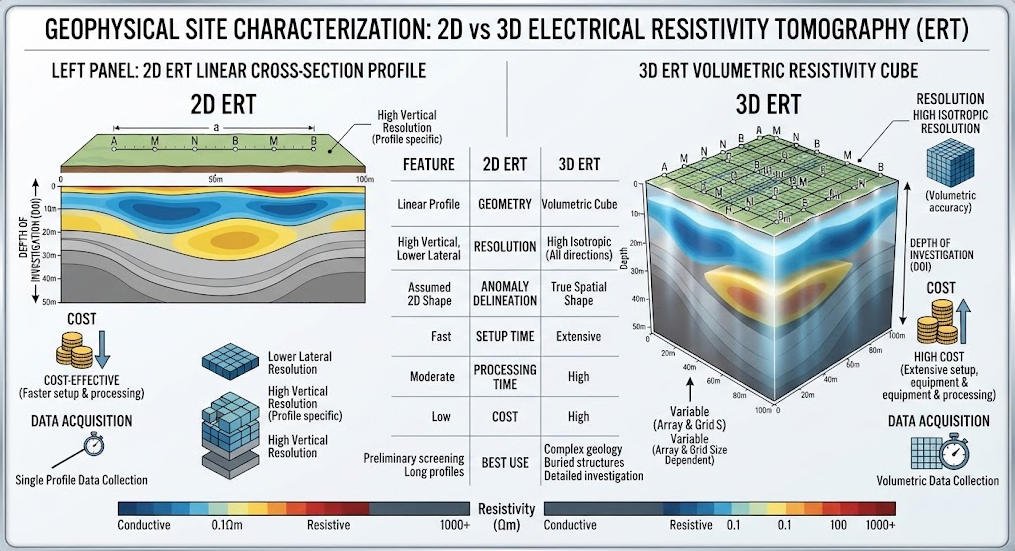
The following table provides a comprehensive side-by-side comparison of 2D and 3D ERT across key technical and economic parameters.
表格
| Parameter | 2D ERT | 3D ERT |
|---|---|---|
| Output format | Vertical cross-sectional profile | Volumetric 3D resistivity model |
| Resolution | Vertical 1–3 m, horizontal 5–10 m | Omnidirectional 0.5–2 m within grid |
| Depth of investigation | ~20–25% of array length | ~15–20% of grid dimension |
| Typical electrode spacing | 1–20 m along line | 2–10 m in grid pattern |
| Field productivity | 2–5 km profile/day (4-person crew) | 0.5–1 km² grid/day (6-person team) |
| Equipment requirement | Portable 32–64 channel system | 128+ channels with grid switching |
| Data processing time | Hours per line | Days to weeks per grid |
| Typical project cost | $3,000–$8,000 per project / $2,000–$5,000/km | $15,000–$50,000 per project / $10,000–$30,000/km² |
| Target suitability | Linear features, layered geology | Complex 3D bodies, cavities, faults |
| Interpretation risk | Off-line features may be distorted or missed | Full 3D localization reduces interpretation bias |
2. Cost Optimization Strategy
A phased investigation approach delivers the best balance of resolution and cost for most projects.
Use 2D ERT for preliminary reconnaissance and linear corridor surveys. It efficiently screens large areas and identifies anomalous zones requiring further investigation. This stage typically accounts for 20–30% of total project budget.
Deploy 3D ERT on priority anomaly zones identified by 2D surveys. Targeted 3D imaging provides detailed characterization of complex features while avoiding the cost of full-area 3D coverage.
For large or complex sites, combine 2D baseline profiles with targeted 3D grids plus complementary methods such as GPR or seismic. This integrated strategy maximizes investigation confidence while controlling costs.
Ⅴ. Multi-Method Integration: ERT-GPR-Seismic Synergy
1. ERT and Ground Penetrating Radar (GPR) Fusion
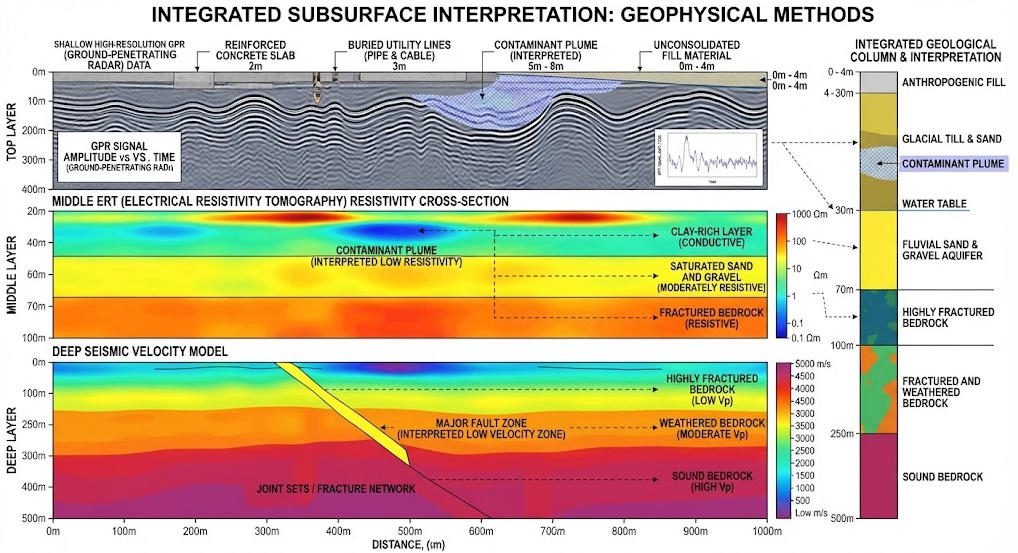
ERT and GPR provide complementary subsurface information with overlapping but distinct depth ranges and sensitivity targets.
ERT maps deeper structures from approximately 5 m up to several hundred meters, with sensitivity to fluid content, lithology and porosity. GPR delivers very high-resolution imaging of the shallow subsurface (0–30 m), detecting layering, voids and small objects.
Fusing both methods creates a complete subsurface model from near surface to depth. ERT fills the depth gap beyond GPR penetration, while GPR adds fine detail to the shallow section that ERT cannot resolve.
Field case studies in mineral exploration have demonstrated up to 40% improvement in ore body targeting accuracy when ERT and GPR data are interpreted jointly.
2. Resistivity and Seismic Data Fusion
Seismic methods provide high-resolution structural imaging based on acoustic velocity contrasts, while ERT provides lithological and fluid information based on electrical properties.
Integrating seismic velocity models as constraints in ERT inversion reduces non-uniqueness and improves geological realism of resistivity models. Joint interpretation achieves higher confidence in fault detection and stratigraphic mapping.
For geothermal and groundwater projects, the combination of seismic structure and resistivity fluid mapping delivers far more robust results than either method alone. Fault detection confidence can exceed 92% with properly calibrated joint interpretation.
3. Trio System Synergy
The ERT-GPR-Seismic trio provides a comprehensive near-surface investigation toolkit. Each method addresses different physical properties, and their combined interpretation reduces ambiguity inherent in any single method.
This integrated approach is standard practice for high-stakes projects such as dam safety assessments, karst hazard evaluation and contaminated site characterization. It provides multiple lines of evidence for critical engineering decisions.
Ⅵ. Typical Equipment and Selection Guide
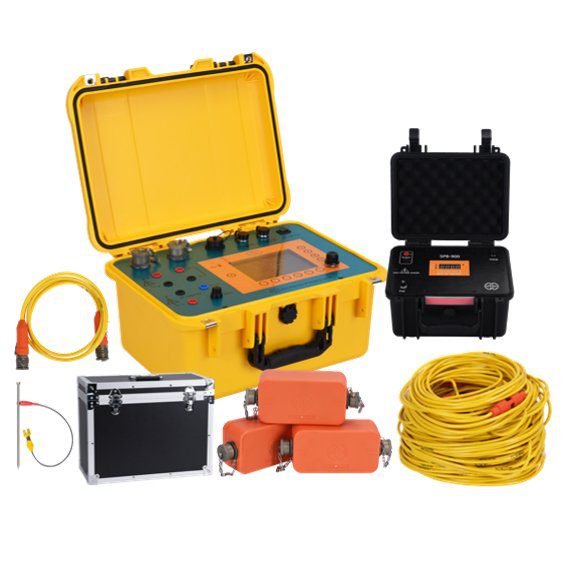
1. GIM-10 Multi-Channel Intelligent Resistivity & IP Meter
The GIM-10 is a high-density ERT system designed for both 2D and 3D surveys, with integrated induced polarization (IP) capability.
Key Technical Specifications
- High-precision acquisition: 24-bit A/D conversion delivering 0.3% measurement accuracy with full waveform recording. Voltage measurement range of ±48 V with common-mode rejection ≥120 dB.
- High-power transmission: 3200 W output (1200 V / 6 A) enabling up to 1500 m penetration depth for deep mineral exploration.
- Multi-mode detection: Combined resistivity and IP measurements supporting 1D, 2D, 3D and 4D time-lapse surveys. 12 preconfigured electrode arrays including Wenner, Schlumberger and dipole-dipole, plus customizable arrays.
- Scalability: Bi-directional cascade controllers support unlimited line expansion for large-scale 3D surveys. Roll-along measurement improves 2D/3D acquisition efficiency by over 50%.
- Environmental rating: IP67 waterproof enclosure, operating temperature range -20°C to +60°C. Titanium electrodes support underwater surveys down to 100 m.
- Software ecosystem: Real-time waveform monitoring, 20-time-window IP analysis, and multi-format export compatible with Res2Dinv, EarthImager and other standard inversion packages.
The GIM-10 weighs 6 kg with built-in lithium battery, balancing field portability with high-end performance suitable for deep mineral exploration and complex engineering projects.
2. Geopro T-Series Ground Penetrating Radar
The Geopro T-Series GPR complements ERT surveys with high-resolution shallow imaging.
Key Technical Specifications
- Multi-antenna support: Compatible with full range of Geopro T-series antennas from 35 MHz to 2500 MHz, covering shallow ultra-high-resolution to deeper penetration applications.
- Intelligent operation: Host unit automatically recognizes antenna type and configures acquisition parameters, reducing setup time and operator error.
- High-speed acquisition: Up to 512 scans per second in time, distance and point measurement modes. Adjustable gain from -10 dB to 160 dB with 9-stage tuning.
- Data management: 128 GB internal storage, project-based dataset merging for longitudinal monitoring. Raw data preservation supports advanced post-processing.
- Integrated positioning: External GPS compatibility for georeferenced data tagging. Digital signal transmission ensures noise-resistant antenna communication.
The system supports applications including tunnel lining inspection, road structure analysis, UXO detection and archaeological imaging.
3. Equipment Selection Criteria
Selecting the right ERT system depends on project objectives, site conditions and budget constraints.
For routine 2D profiling and standard engineering surveys, a 32–64 channel portable system provides sufficient capability at moderate cost. For large 3D grids and deep exploration, 128+ channel systems with high-power transmitters are required.
IP capability adds value for mineral exploration and landfill investigations where chargeability provides additional discrimination beyond resistivity alone.
Accessory selection should match project environment: borehole cables for cross-hole surveys, marine electrodes for underwater work, and anti-interference cables for urban surveys.
Ⅶ. Major Application Domains
1. Engineering Geology and Infrastructure
ERT is widely used for pre-construction site characterization, tunnel alignment investigation and dam foundation assessment. 2D profiles cover linear infrastructure corridors, while 3D ERT targets specific hazard zones.
Karst detection is a particularly important application. 3D ERT accurately maps cave geometry, sinkhole development and fractured rock volumes, providing critical data for foundation design and hazard mitigation.
Levee and dam integrity surveys use 2D ERT profiles to detect seepage paths, internal erosion and weak zones. Time-lapse 3D ERT can monitor changes during reservoir filling and flood events.
2. Environmental and Hydrogeological Investigations
Landfill contamination monitoring is a major environmental application of ERT. Leachate plumes create distinct low-resistivity anomalies that can be mapped and monitored over time. 3D ERT provides volumetric plume definition for remediation design.
Groundwater investigations use ERT to map aquifer geometry, saline intrusion and contamination plumes. 2D cross-sections define aquifer structure, while 3D surveys model plume migration pathways.
For contaminated site assessment, staged 2D screening followed by targeted 3D imaging is the standard best practice approach.
3. Mineral and Geothermal Exploration
In mineral exploration, ERT (often combined with IP) maps sulfide ore bodies, graphite deposits and clay alteration zones. 2D profiles provide reconnaissance coverage, while 3D grids define ore body geometry for resource estimation.
Deep-penetration high-power ERT systems reach 1000–1500 m depth, covering the range of many near-surface and intermediate depth deposits. IP data adds mineralogical information that improves discrimination between ore and waste.
Geothermal exploration uses ERT to map permeable fracture zones and clay alteration caps associated with hydrothermal systems. 3D ERT defines reservoir geometry for well placement.
4. Urban and Underground Infrastructure
Urban underground utility surveys use high-resolution 2D ERT to detect pipelines, cavities and structural anomalies. Combined with GPR, it provides complete coverage from shallow utilities to deeper geological features.
Bridge foundation assessment and railway subgrade evaluation use ERT to assess subsurface conditions without disrupting operations. Time-lapse surveys monitor long-term degradation.
Archaeological investigations use high-resolution ERT to map buried structures, pits and ditches. 3D ERT can reveal complex site layouts that would be invisible to 2D profiles alone.
Ⅷ. Project Design Best Practices
1. Survey Design Workflow
Effective ERT project design follows a structured workflow from objectives to final deliverables.
First, clearly define investigation objectives: target depth, required resolution, and the geological or engineering question to be answered. These parameters drive all subsequent design decisions.
Second, select the appropriate survey dimension. Use 2D for linear features, reconnaissance and layered geology. Use 3D for complex targets, volumetric analysis and sites where off-line features are expected.
Third, choose electrode spacing and array configuration based on target depth and resolution requirements. Smaller spacing gives higher resolution but shallower penetration and higher cost per unit length.
2. Data Quality Assurance
Data quality is critical for reliable ERT interpretation. Implement multiple quality control measures throughout field acquisition and processing.
Field QC includes electrode contact resistance testing before each measurement cycle, reciprocal measurements to check system bias, and repeat readings at control stations to assess repeatability.
Processing QC involves bad data removal, drift correction and inversion convergence monitoring. Multiple inversion runs with different parameters test model stability and reliability.
All projects should include ground-truth verification at selected locations. Borehole data, trial pits and direct sampling calibrate resistivity values to actual geological units.
3. Cost Optimization Framework
Optimize project cost by matching survey method to investigation phase.
Phase 1 (Reconnaissance): 2D ERT profiles at wide spacing for regional screening and anomaly identification. Phase 2 (Detailed investigation): Infill 2D lines and targeted 3D grids over priority anomalies. Phase 3 (Verification): Ground-truthing and complementary methods at key locations.
This tiered approach avoids over-investment in low-priority areas while ensuring high-resolution coverage where it matters most.
Ⅸ. Limitations and Considerations
1. Inherent Method Limitations
ERT shares fundamental limitations common to all surface geophysical methods. Resolution decreases with depth, and deep features appear broader and less defined than shallow features.
Non-uniqueness is an inherent property of resistivity inversion. Different subsurface resistivity distributions can produce identical surface measurements. Interpretation must always consider geological plausibility and be calibrated with ground truth.
Surface topography, near-surface heterogeneity and cultural interference can all produce artifacts in ERT images. Advanced inversion algorithms can partially compensate for these effects but cannot eliminate them entirely.
2. Site-Specific Considerations
ERT performance varies significantly with site conditions. Resistive overburden such as dry gravel or bedrock at surface reduces current penetration and limits investigation depth.
Very conductive sites such as salt marshes or contaminated ground shunt current near the surface, also reducing effective depth. High background electrical noise from power lines and industrial facilities degrades data quality.
Site access constraints may limit grid design and line layout. Urban sites often require irregular electrode configurations that reduce data quality compared to ideal grid patterns.
3. Interpretation Best Practices
ERT interpretation should always be performed by qualified geophysicists with geological expertise. Resistivity values alone do not identify geological units; they must be interpreted within the local geological context.
Avoid over-interpreting small features near the limits of resolution. Report confidence levels alongside interpretation results, clearly distinguishing between well-resolved and poorly constrained features.
For critical engineering decisions, always support ERT results with independent evidence from boreholes, other geophysical methods or direct investigation.
Related Articles
| Title | Core Content | URL |
|---|---|---|
| Introduction to ERT and Time-Domain Induced Polarization | Explains ERT and TDIP principles, electrode arrays, data acquisition and environmental applications | https://geotechcn.net/service/ert-tdip-geophysical-survey/ |
| What is Continuous Resistivity Profiling? | Covers waterborne ERT technology, towed streamer systems and coastal hydrogeological applications | https://geotechcn.net/service/what-is-continuous-resistivity-profiling/ |
| What is Vertical Electrical Sounding (VES)? | Details DC resistivity sounding theory, Schlumberger array and groundwater exploration applications | https://geotechcn.net/service/what-is-ves-ert-systems/ |
| High-Density Electrical Resistivity Survey Principle | Explains high-density ERT system architecture, inversion algorithms and engineering geology applications | https://geotechcn.net/service/electrical-method/ |
| Electrical vs Electromagnetic Survey Methods | Compares DC resistivity and electromagnetic geophysical methods across principles, equipment and use cases | https://geotechcn.net/service/electrical-vs-electromagnetic-survey/ |
Reference Sources
| Title | Core Content | URL |
|---|---|---|
| Electrical Resistivity Tomography | EPA technical reference covering ERT principles, equipment, data interpretation and environmental applications | https://www.epa.gov/environmental-geophysics/electrical-resistivity-tomography |
| 2D and 3D Electrical Resistivity Imaging for Site Characterization | USGS publication comparing 2D and 3D ERT performance with field case examples | https://pubs.usgs.gov/sir/2006/5102/ |
| Comparison of 2D and 3D ERT for Karst Cave Detection | Peer-reviewed research evaluating ERT dimensionality effects on karst feature characterization | https://academic.oup.com/jge/article/18/3/597/6297618 |
| High-Density Resistivity in Engineering Geophysics | ISGE technical report on modern multi-channel ERT systems and field data quality | https://www.isge.org/publications/technical-reports/high-density-resistivity-engineering-geophysics |
| Electrical Resistivity Tomography Guidelines | SEG technical wiki covering ERT survey design, inversion practices and interpretation standards | https://wiki.seg.org/wiki/Electrical_resistivity_tomography |
FAQ
Q1: What is the main difference between 2D and 3D ERT?
2D ERT produces vertical cross-sections along linear electrode arrays, while 3D ERT generates volumetric resistivity models from grid-based electrode networks. 2D is faster and cheaper for linear surveys, while 3D resolves complex off-line features like caves and faults. The staged approach uses 2D screening before targeted 3D investigation.
Q2: How deep can standard ERT surveys penetrate?
Standard surface ERT typically reaches depths equal to 15–25% of total array or grid length. High-power systems like the GIM-10 can achieve up to 1500 m depth with long electrode spreads. Actual depth depends on array type, subsurface resistivity and noise conditions. Deeper targets require larger electrode spacing and higher transmitter power.
Q3: When should I choose 3D ERT over 2D ERT?
Choose 3D ERT when investigating complex 3D geological features such as karst caves, sinkholes, ore bodies and fault zones. 3D is also preferred when accurate volumetric quantification is required for contaminant plumes or resource estimation. For linear corridors and layered geology, 2D ERT usually provides sufficient data at lower cost.
Q4: What electrode array is best for ERT surveys?
No single array is universally best. Wenner arrays provide strong signals and good vertical resolution for layered geology. Dipole-dipole arrays offer superior horizontal resolution for lateral features like faults. Schlumberger arrays deliver deeper penetration for regional surveys. Most modern systems support multiple arrays; selection depends on target geometry and site conditions.
Q5: Can ERT be combined with other geophysical methods?
Yes, ERT is commonly combined with GPR and seismic methods for more robust subsurface interpretation. GPR adds high-resolution shallow detail, while seismic provides structural velocity data that constrains ERT inversion. Joint interpretation reduces ambiguity and improves detection confidence by 30–40% compared to single-method surveys.