Welcome to Geotech!
-1.png)


Proton Magnetometer Sensitivity: Is 0.05 nT Necessary for Geological Prospecting?
Overview:A 0.05 nT proton magnetometer can provide high measurement sensitivity for detecting subtle magnetic-field variations, but 0.05 nT is not a universal requirement for every geological survey. The appropriate specification depends on the expected magnetic anomaly, background noise, survey spacing, target depth, magnetic gradient, sampling requirements, and interpretation objectives. This guide explains proton magnetometer sensitivity, the meaning of 0.05 nT, and the key specifications engineers should evaluate when selecting magnetic survey equipment.
I. What Is Proton Magnetometer Sensitivity?
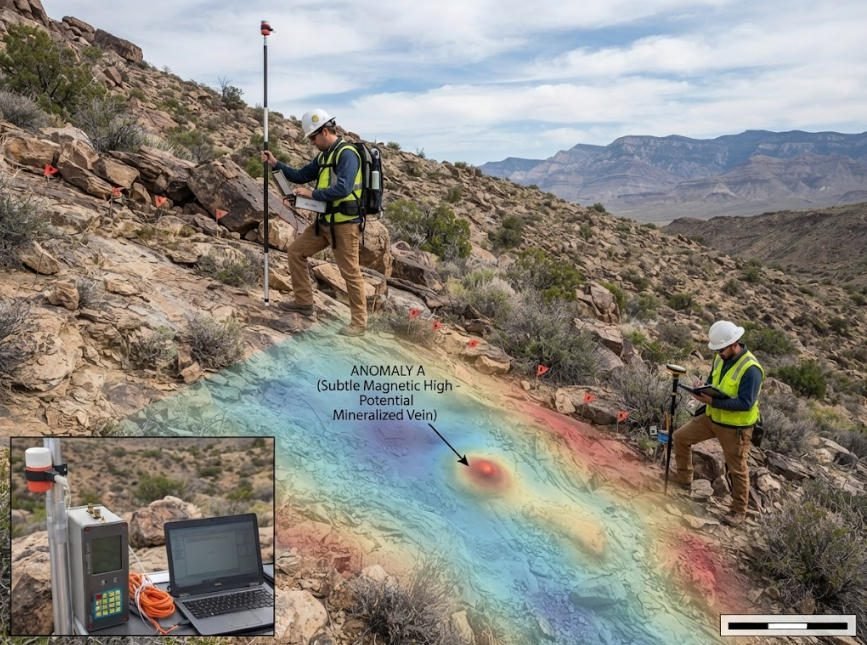
Magnetic surveying measures variations in the Earth’s magnetic field to investigate geological structures, mineralization, buried objects, archaeological features, and other subsurface targets.
A proton magnetometer measures the total intensity of the magnetic field using the proton precession principle. After hydrogen-rich material inside the sensor is polarized, the protons precess around the ambient magnetic field. The precession frequency is directly related to magnetic-field strength.
The relationship can be expressed as:
where:
- f = proton precession frequency
- γ = proton gyromagnetic ratio
- B = magnetic field intensity
USGS documentation describes the same fundamental principle and notes that proton magnetometers can determine the total magnetic field from the measured proton precession frequency.
This makes proton precession magnetometers useful for total-field magnetic surveys and absolute magnetic-field measurements.
But what exactly does 0.05 nT sensitivity mean?
II. What Does 0.05 nT Mean?
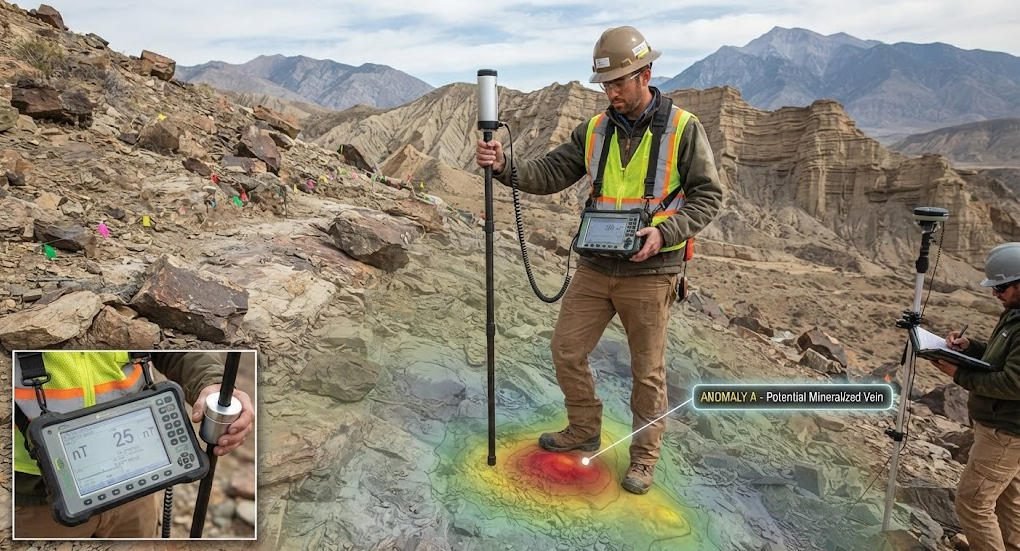
A nanotesla (nT) is a unit used to describe magnetic-field intensity.
When a magnetometer is specified with a sensitivity of 0.05 nT, the specification indicates its capability to resolve relatively small changes in magnetic field under the manufacturer’s defined measurement conditions.
This can be valuable when the geological target produces a subtle magnetic anomaly.
However, engineers should avoid treating:
0.05 nT sensitivity = 0.05 nT accuracy = 0.05 nT field noise
These are different concepts.
A professional equipment specification should distinguish between sensitivity, resolution, accuracy, repeatability, sampling interval, and other system-level characteristics.
Historical USGS magnetic observations illustrate why this distinction matters: field measurements can contain instrument noise, environmental effects, site-to-site magnetic differences, and other sources of variation even when the instrument itself has a defined sensitivity.
III. Sensitivity vs. Resolution vs. Accuracy
These three terms are frequently confused when comparing magnetometers.
| Parameter | What It Describes | Practical Importance |
|---|---|---|
| Sensitivity | Ability to respond to small magnetic-field changes | Weak anomaly detection |
| Resolution | Smallest distinguishable measurement increment | Data detail |
| Accuracy | Agreement between measured and reference value | Quantitative measurement |
| Repeatability | Consistency between repeated measurements | Survey reliability |
| Sampling Rate | Frequency of measurements | Spatial sampling during movement |
A magnetometer can have a very fine numerical resolution without having the same absolute accuracy.
Therefore, a more useful equipment-selection question is not:
Which magnetometer has the smallest nT specification?
It is:
Can the complete measurement system reliably resolve the magnetic anomaly relevant to the survey objective?
IV. When Is 0.05 nT Sensitivity Useful?
The value of high sensitivity depends on the relationship between the target anomaly and the background magnetic environment.
4.1 Mineral Exploration
Magnetic surveying is widely used in mineral exploration because contrasts in magnetic susceptibility and remanent magnetization can help identify geological units and structures.
High-sensitivity magnetic equipment can be useful when investigating:
- weak magnetic anomalies;
- subtle lithological contacts;
- magnetic lineaments;
- structural boundaries;
- detailed follow-up surveys;
- small-scale magnetic features.
USGS describes total-intensity magnetic data as an important source of information for geological interpretation and mineral exploration. Recent USGS work also highlights the role of high-quality magnetic datasets in regional mineral-resource investigations.
However, not every mineral exploration target requires the same instrument sensitivity.
A strongly magnetic target may generate a large anomaly that can be identified with a range of instruments.
A weak anomaly may require substantially greater measurement capability.
4.2 Geological Mapping
Magnetic data can help distinguish geological units with different magnetic properties.
Detailed magnetic mapping may be used to investigate:
- lithological boundaries;
- faults;
- fractures;
- intrusive bodies;
- basement structures;
- alteration-related magnetic changes.
In these applications, the value of higher sensitivity depends on the magnetic contrast and survey design.
A high-sensitivity instrument does not replace appropriate line spacing, positioning, quality control, or geological interpretation.
4.3 Archaeological Surveys
Magnetic methods can also detect shallow buried features that produce magnetic contrasts.
Potential targets include:
- foundations;
- pits;
- ditches;
- fired materials;
- buried structures;
- archaeological remains.
For these surveys, target size, depth, material properties, survey spacing, and cultural noise can be more important than a single sensitivity specification.
4.4 Engineering and Environmental Surveys
Magnetic surveys can also support investigations of:
- buried ferrous objects;
- pipelines;
- abandoned infrastructure;
- underground metallic structures;
- construction areas;
- geological hazards.
In urban or industrial environments, however, magnetic interference from vehicles, buildings, fences, cables, and other metal structures can dominate the measurement environment.
Therefore:
Higher instrument sensitivity cannot compensate for uncontrolled magnetic interference.
V. Why Magnetic Gradient Matters
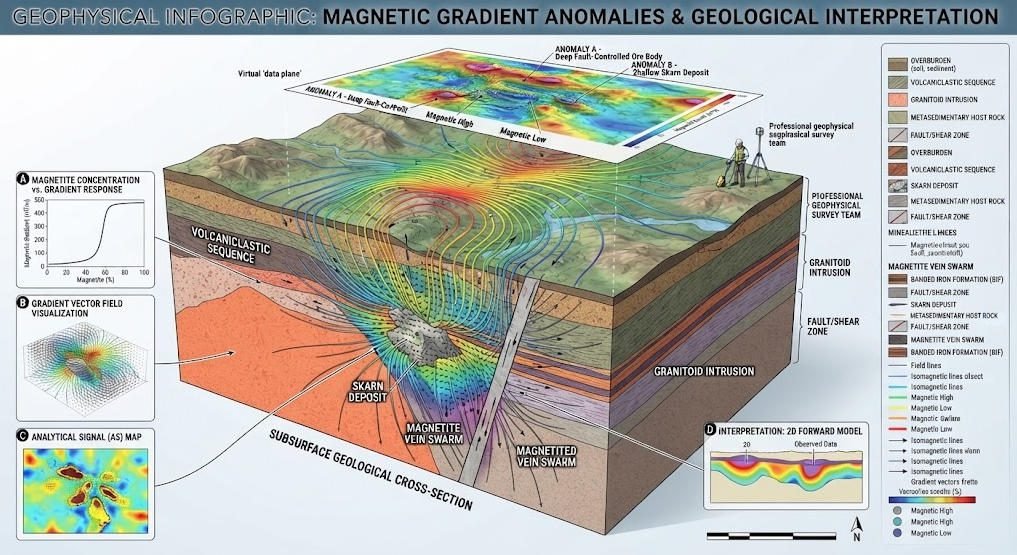
Sensitivity is only one part of magnetometer performance.
Another important parameter is magnetic gradient.
Magnetic gradient describes how rapidly the magnetic field changes over distance:
where:
- G = magnetic gradient
- ΔB = change in magnetic field
- Δx = distance
Strong gradients may occur near:
- magnetite-rich formations;
- strongly magnetic mineralization;
- buried steel;
- pipelines;
- archaeological metal;
- geological contacts;
- industrial infrastructure.
In these conditions, a magnetometer must maintain stable measurements while the magnetic field changes rapidly.
Therefore, when comparing equipment for complex terrain, engineers should evaluate:
Sensitivity + Gradient Capability + Dynamic Range
rather than sensitivity alone.
VI. Proton Magnetometer vs. Other Magnetometer Technologies
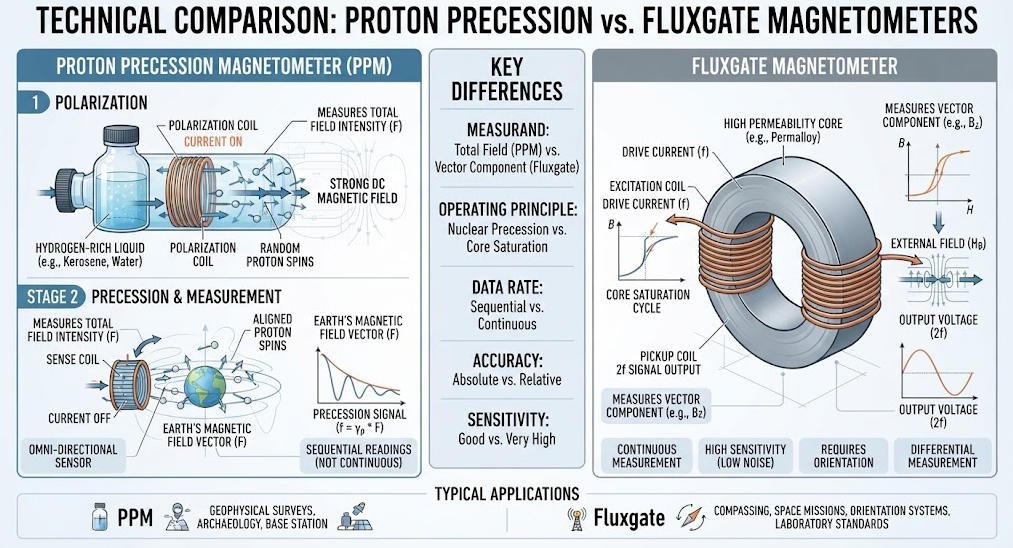
The phrase “traditional magnetometer” can be misleading because there are several different magnetometer technologies.
Common technologies include:
- Proton precession magnetometers;
- Overhauser magnetometers;
- Cesium-vapor magnetometers;
- Other optically pumped magnetometers;
- Fluxgate magnetometers;
- Magnetoresistive sensors;
- Hall-effect sensors.
Each technology has different characteristics.
| Technology | Typical Measurement Concept | Important Considerations |
|---|---|---|
| Proton precession | Proton resonance frequency | Total-field measurement, sensitivity, sampling rate |
| Overhauser | Enhanced proton precession | Sensitivity, sampling performance |
| Cesium vapor | Optical pumping | High sensitivity and fast sampling |
| Fluxgate | Vector magnetic field | Directional measurement |
| Magnetoresistive | Solid-state magnetic sensing | Compact size and integration |
| Hall effect | Hall voltage response | General magnetic-field sensing |
USGS observatory systems illustrate the complementary roles of proton and fluxgate magnetometers: proton magnetometers can provide total-field measurements, while fluxgate systems provide vector components.
Therefore, the question should not simply be:
“Which technology is best?”
Instead:
Which technology matches the measurement objective?
VII. Why Frequency Stability Matters
A proton magnetometer derives magnetic-field information from proton precession frequency.
Consequently, frequency stability is an important part of the measurement chain.
Some high-performance systems use a temperature-controlled oscillator such as an OCXO (Oven-Controlled Crystal Oscillator) to improve oscillator frequency stability.
This should be described accurately:
An OCXO improves oscillator frequency stability; it does not eliminate all sources of temperature-related measurement error.
Other factors can still affect field measurements:
- sensor temperature;
- electronics;
- environmental magnetic interference;
- sensor positioning;
- instrument calibration;
- magnetic gradients;
- field operation.
This distinction is important when writing technical product specifications.
VIII. How to Select a High-Sensitivity Magnetometer
Professional magnetometer selection should begin with the survey objective.
8.1 Define the Target
Determine:
- target type;
- approximate depth;
- expected magnetic contrast;
- target dimensions.
8.2 Estimate the Magnetic Environment
Consider:
- regional magnetic field;
- cultural noise;
- nearby metallic objects;
- expected magnetic gradient;
- temporal magnetic-field variation.
8.3 Define Measurement Requirements
Specify:
- sensitivity;
- resolution;
- accuracy;
- sampling rate;
- dynamic range;
- positioning requirements.
8.4 Select the Sensor Configuration
Depending on the project, this may include:
- single-sensor configuration;
- dual-sensor configuration;
- base-station operation;
- walking survey;
- vehicle-mounted survey.
8.5 Evaluate the Data Workflow
A professional magnetic survey may also require:
- GNSS positioning;
- time synchronization;
- base-station correction;
- diurnal correction;
- filtering;
- gridding;
- anomaly mapping;
- 2D/3D interpretation.
The instrument is therefore only one component of the complete survey system.
IX. Single-Sensor vs. Dual-Sensor Magnetometers
A single-sensor proton magnetometer is suitable for many conventional total-field magnetic surveys.
A dual-sensor configuration can provide additional spatial information and may be useful for magnetic-gradient or detailed anomaly surveys.
| Feature | Single Sensor | Dual Sensor |
|---|---|---|
| Total magnetic field | ✓ | ✓ |
| Basic magnetic profiling | ✓ | ✓ |
| Spatial comparison | Limited | Improved |
| Gradient-oriented surveys | Possible with survey design | More suitable |
| Equipment complexity | Lower | Higher |
| Typical application | General magnetic surveys | Detailed magnetic/gradient surveys |
The choice should depend on the survey objective rather than assuming that two sensors automatically provide twice the accuracy.
X. Does Every Geological Survey Need 0.05 nT?
No.
The appropriate magnetometer specification depends on the project.
A 0.05 nT-class instrument may be particularly useful when:
- the expected anomaly is weak;
- detailed magnetic mapping is required;
- subtle geological boundaries are important;
- the survey requires high measurement capability;
- the project involves small magnetic targets.
But a less sensitive instrument may be entirely appropriate when:
- anomalies are large;
- the target produces strong magnetic contrast;
- the survey is reconnaissance-scale;
- environmental noise dominates;
- the survey objective does not require extremely fine magnetic resolution.
Historical USGS work demonstrates that proton magnetometers with different sensitivity levels have been used for different scientific and monitoring applications.
So 0.05 nT should be considered an equipment capability, not a universal pass/fail threshold.
XI. GEOTECH JPMG Proton Magnetometer
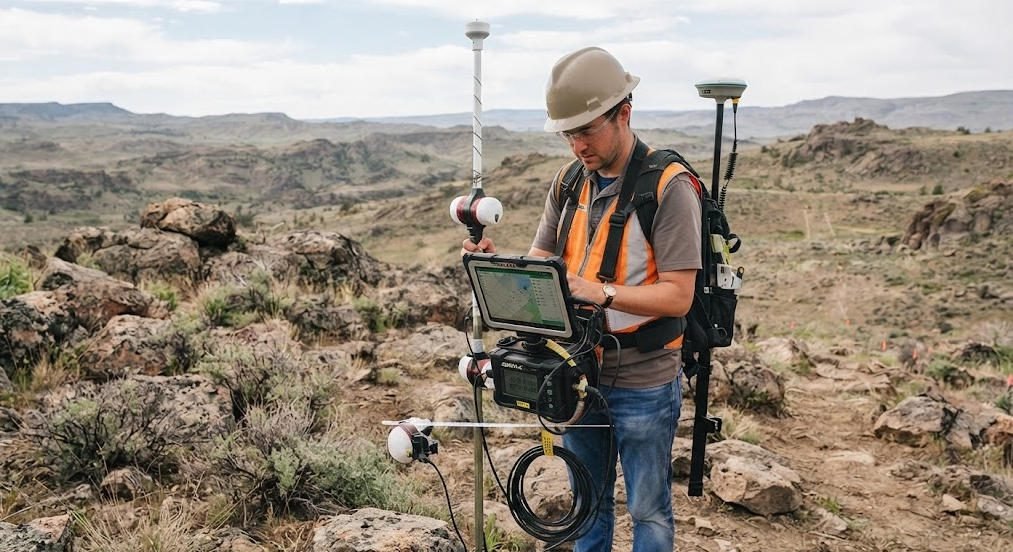
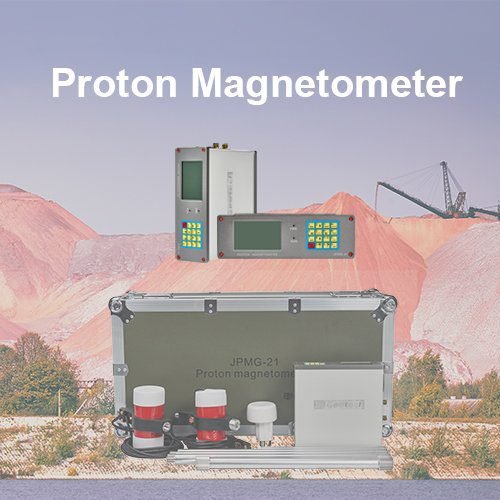
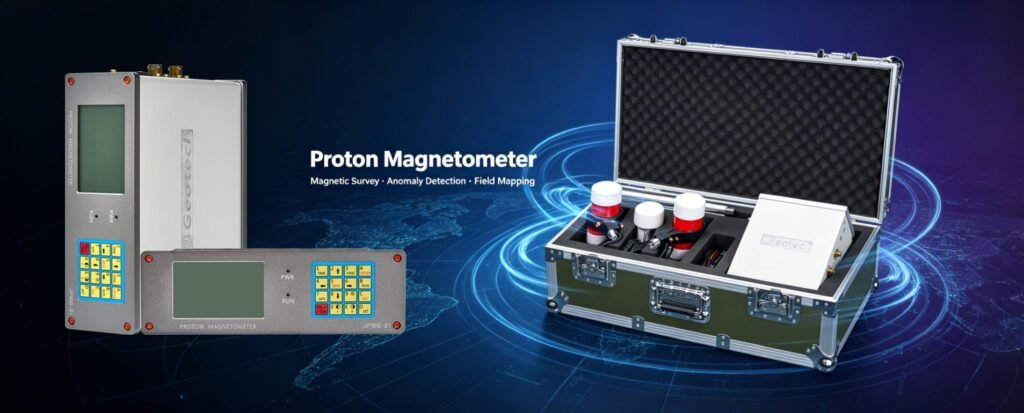
For professional magnetic exploration, GEOTECH provides the JPMG Proton Magnetometer platform.
The JPMG product family is designed for total-field magnetic measurement based on proton precession technology and can be applied to projects such as:
- mineral exploration;
- geological mapping;
- archaeological investigation;
- magnetic anomaly mapping;
- engineering investigation;
- geophysical field surveys.
For equipment selection, engineers should evaluate the exact product configuration and verify parameters including:
- sensitivity;
- resolution;
- absolute accuracy;
- sampling interval;
- gradient capability;
- frequency stability;
- positioning;
- environmental protection;
- single- or dual-sensor configuration.
The important point is to evaluate the complete specification, rather than using sensitivity as the only purchasing criterion.
XII. What Determines Magnetic Survey Data Quality?
A high-performance magnetometer alone does not guarantee high-quality geological interpretation.
A more complete model is:
Instrument + Sensor Position + Survey Design + GNSS + Sampling + Environmental Noise + Processing
Instrument
Determines measurement capability.
Sensor Position
Sensor height and positioning affect the spatial relationship between the instrument and the target.
Survey Design
Line spacing and orientation determine whether the target can be adequately sampled.
GNSS
Accurate positioning is essential for correctly locating anomalies.
Sampling
Sampling interval determines the spatial density of magnetic observations.
Environmental Noise
Vehicles, steel structures, power infrastructure and other magnetic sources can contaminate data.
Processing
Filtering, leveling, correction and gridding influence the final magnetic map.
Therefore, a 0.05 nT specification should never be interpreted as a guarantee that every field measurement will have 0.05 nT uncertainty.
XIII. 0.05 nT Sensitivity: What It Means and What It Does Not
It means:
A high-sensitivity specification indicates the instrument is designed to resolve small changes in magnetic field under defined conditions.
It does not mean:
- every 0.05 nT variation is geological;
- absolute accuracy is automatically 0.05 nT;
- field noise is automatically 0.05 nT;
- every project requires 0.05 nT;
- deeper anomalies automatically become detectable;
- the instrument is universally superior to other magnetometer technologies.
This distinction makes technical magnetometer content more useful to professional engineers and more defensible from an E-E-A-T perspective.
XIV. Practical Magnetometer Selection Checklist
Before purchasing magnetic survey equipment, ask:
Target
- How large is the expected anomaly?
- How deep is the target?
- What magnetic contrast is expected?
Environment
- Is the area magnetically quiet?
- Are vehicles or steel structures nearby?
- Are strong magnetic gradients expected?
Instrument
- What is the sensitivity?
- What is the resolution?
- What is the accuracy?
- What is the sampling interval?
- What is the gradient capability?
Survey
- Walking or vehicle-based?
- Required line spacing?
- Single or dual sensor?
- Is a base station required?
Data
- GNSS integration?
- Time synchronization?
- Diurnal correction?
- Processing software?
- Export formats?
This checklist is more useful than comparing a single number on different product datasheets.
XV. Conclusion
A 0.05 nT proton magnetometer provides high measurement capability for surveys where subtle magnetic-field variations are important.
However, 0.05 nT is not a universal requirement for geological prospecting.
The appropriate specification depends on:
- target anomaly amplitude;
- geological setting;
- background magnetic noise;
- magnetic gradient;
- target depth;
- survey spacing;
- sampling requirements;
- data-processing workflow.
For professional magnetic exploration, the best equipment-selection strategy is therefore to evaluate the complete magnetic measurement system, rather than focusing on sensitivity alone.
GEOTECH’s JPMG Proton Magnetometer platform can be considered for applications requiring high-sensitivity total-field magnetic measurements, with the final configuration selected according to the specific survey requirements.
Related Articles
| Anchor Text | Internal URL | Core Content |
|---|---|---|
| Magnetic Instruments | https://geotechcn.net//products/magnetic-instrument/ | Category |
| Proton Magnetometer | https://geotechcn.net/products/magnetic-instrument/proton-magnetometer-single/ | Product |
| Dual-Sensor Proton Magnetometer | https://geotechcn.net/products/magnetic-instrument/dual-sensor-proton-magnetometer/ | Product |
| Proton Magnetometer Principles | https://geotechcn.net/service/proton-magnetometer-from-hydrogen-atom-polarization-to-accurate-magnetic-field-measurement/ | Core Principle |
| Proton Precession Magnetometer | https://geotechcn.net/service/proton-precession-magnetometer/ | Technology |
| How Proton Precession Works | https://geotechcn.net/service/how-proton-precession-works-in-measurement/ | Measurement |
| Proton Magnetometer Signal Processing | https://geotechcn.net/service/proton-magnetometer-signal-processing/ | Data Processing |
Reference Sources
| Authority Source | Recommended Use |
|---|---|
| USGS Geomagnetism | Proton magnetometer、geomagnetic measurement |
| USGS Instrumentation | Proton / fluxgate instrumentation |
| USGS Magnetic Field Studies | Magnetic survey data and geological interpretation |
| British Geological Survey Geomagnetism | Geomagnetic measurement and proton magnetometers |
| Society of Exploration Geophysicists | Exploration geophysics industry authority |
FAQ
Q1.What does 0.05 nT sensitivity mean in a proton magnetometer?
A 0.05 nT sensitivity specification indicates that a proton magnetometer is designed to resolve small changes in magnetic field under specified conditions. It does not mean that the instrument has 0.05 nT absolute accuracy or that every 0.05 nT variation represents a geological anomaly.
Q2.Is a 0.05 nT proton magnetometer necessary for mineral exploration?
Not necessarily. Required sensitivity depends on target anomaly strength, background noise, target depth, survey spacing and geological conditions. A 0.05 nT-class instrument can provide useful measurement capability for weak anomalies, but sensitivity should be evaluated together with accuracy, sampling and environmental performance.
Q3.What is the difference between sensitivity and accuracy?
Sensitivity describes the ability to detect small changes in magnetic field, while accuracy describes how closely the measurement agrees with the true or reference value. These are different specifications and should not be treated as interchangeable.
Q4.Why is magnetic gradient capability important?
Magnetic gradient capability matters when the field changes rapidly over a short distance, such as near magnetic mineralization, buried metal, geological contacts or infrastructure. A suitable magnetometer should remain stable under the expected field conditions.
Q5.Is a proton magnetometer better than other magnetometer technologies?
No single technology is universally optimal. Proton, Overhauser, optically pumped and fluxgate magnetometers have different characteristics. The appropriate technology depends on the required field measurement, sensitivity, sampling rate, environment and survey objectives.