Welcome to Geotech!
-1.png)

Wideband MT Instruments for Deep Exploration
TIPS:Wideband MT instruments have redefined how geophysical teams approach subsurface mapping. A single wideband MT instrument captures electromagnetic data from audio frequencies down to ultra-long periods, eliminating the need to swap hardware between shallow and deep targets. This capability makes the wideband MT instrument the preferred deep exploration instrument for modern mineral, geothermal, and hydrocarbon surveys. By delivering continuous resistivity profiles from surface to crustal depths, the deep exploration instrument reduces field time, cuts logistics costs, and produces higher-fidelity earth models than traditional single-band systems.
Ⅰ. Introduction: The Efficiency Gap in Traditional Single-Band Surveys
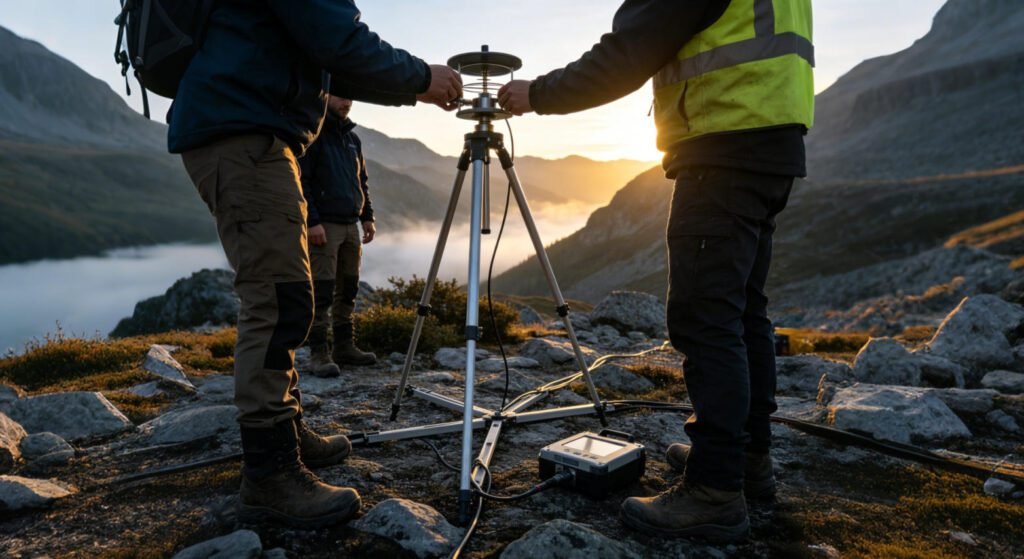
Field geophysicists have long faced a frustrating reality. Single-band magnetotelluric systems force teams to deploy separate instruments for shallow audio-magnetotelluric (AMT) work and deep crustal magnetotelluric (MT) investigations. This hardware fragmentation creates scheduling bottlenecks. It inflates equipment budgets. It also introduces data compatibility risks during interpretation.
The global magnetotelluric system market reached USD 847.2 million in 2025. Analysts project it will grow to USD 1,423.8 million by 2034 at a 5.9% CAGR. Much of this growth stems from exploration companies replacing narrow-band legacy systems with unified wideband platforms.
Wideband MT instruments solve the single-band dilemma. They integrate high-frequency AMT, broadband MT, and long-period MT capabilities into one acquisition unit. A single station can record natural electromagnetic fields from 10 kHz down to 0.0001 Hz without hardware swaps.
This seamless frequency coverage translates directly into operational advantages. It reshapes survey economics.
Ⅱ. Understanding Wideband MT Technology
1. Frequency Range and Technical Foundation
Magnetotelluric methods rely on naturally occurring electromagnetic fields. Lightning discharges generate high-frequency signals in the audio band. Ionospheric resonances and solar wind interactions produce lower-frequency energy. The Earth filters these signals based on frequency. High frequencies attenuate rapidly. Low frequencies penetrate deep into the crust.
Wideband MT instruments exploit this physics. They measure the full spectrum in one continuous sweep. Modern systems capture frequencies from 10 kHz to 0.00001 Hz.
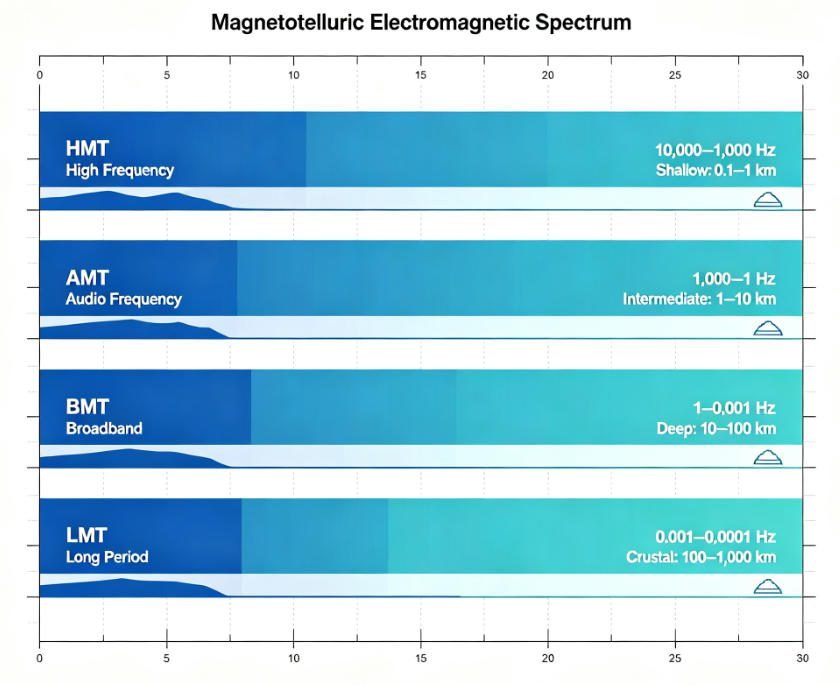
This range spans four distinct bands:
- High-frequency magnetotellurics (HMT): 100 kHz to 10 Hz for near-surface resolution
- Audio magnetotellurics (AMT): 10 kHz to 0.1 Hz for intermediate depths
- Broadband MT (BMT): 1 kHz to 10,000 s period for deep structures
- Long-period MT (LPMT): below 1 Hz for crustal and mantle imaging
The skin-depth relationship governs penetration. Lower frequencies probe deeper. Electromagnetic energy diffuses farther into conductive rock before decaying. A wideband system captures the complete depth column in one deployment. It does not stitch together disjointed datasets from separate instruments.
2. How Wideband Differs from Single-Band Systems
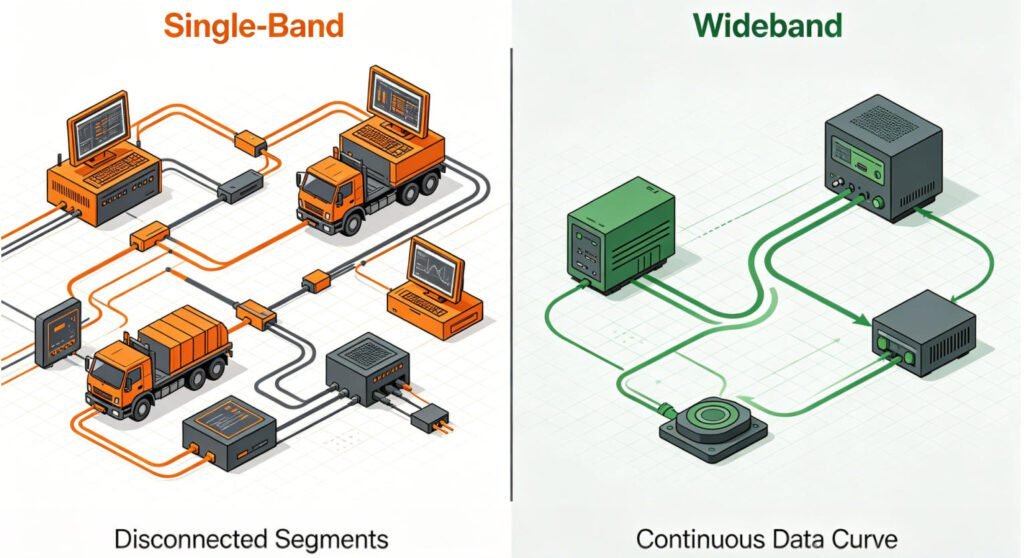
Traditional single-band instruments specialize in narrow frequency windows. An AMT unit may cover 1 Hz to 20 kHz. A long-period MT system might record only below 1 Hz. When a project needs both shallow aquifer mapping and deep basement characterization, crews must mobilize two distinct hardware packages.
Wideband architecture eliminates this redundancy. One data logger, one set of induction coils, and one electrode array handle the entire spectrum. Field crews save hours per station. They avoid equipment swaps. Data processing pipelines benefit from uniform calibration. They also enjoy consistent noise characteristics across all frequencies.
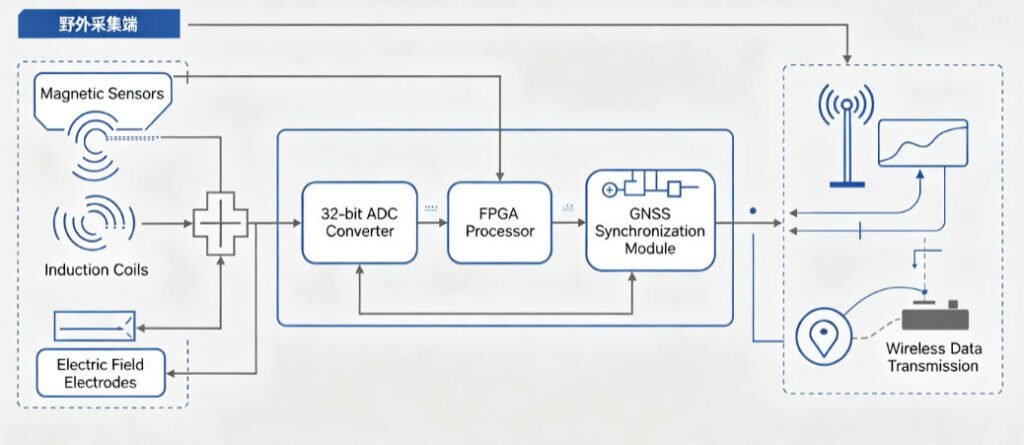
The technical distinction extends to sensor design. Wideband induction coils maintain flat response curves across decades of frequency. Advanced 24-bit or 32-bit ADC converters preserve signal fidelity at the high end. They maintain low noise floors at long periods.
Ⅲ. Three Core Advantages of Wideband Design
1. Full Depth Coverage from Surface to Crust
The primary advantage of a wideband MT instrument is unified depth coverage. Single-band surveys create artificial boundaries in the subsurface model. AMT data may resolve the first kilometer. Long-period MT data picks up below two kilometers. The gap between these bands forces interpreters to extrapolate. They must acquire overlapping stations.
Wideband systems record continuous impedance tensors from near-surface to tens of kilometers depth. In the Gonghe Basin geothermal study, researchers used broadband MT instruments to image structures from surface sediments down to deep geothermal reservoirs. The continuous frequency coverage revealed fault patterns and fluid pathways. Narrow-band data would have missed these features.
This full-spectrum capability proves especially valuable in complex geological settings. Mineral systems require resolution of shallow alteration zones, intermediate-depth stockwork, and deep-seated source intrusions. A wideband survey captures all these scales. It does so without switching coils or reconfiguring acquisition parameters.
2. Higher Field Efficiency and Cost Reduction
Time in the field costs money. Every equipment swap adds setup minutes. It requires calibration checks. It also introduces potential human error. Wideband MT instruments reduce station occupation time. They consolidate acquisition into a single session.
Consider a typical deep exploration project. A single-band MT crew might spend 20 hours at a station. They use 2 hours for AMT setup and recording. Then they perform a hardware swap. Then they record 18 hours for long-period acquisition. A wideband crew deploys once. They record continuously for 12 to 20 hours. They capture both bands simultaneously. The station count drops because one wideband site replaces two single-band sites.
Logistics savings compound this benefit. Fewer instruments mean lighter shipping weights. They reduce spare parts inventory. They also enable smaller field teams. The National Geoelectromagnetic Facility at Oregon State University manages wideband ZEN Rx6 systems. They chose these platforms precisely because their portability and unified design suit remote deployments.
3. Continuous Data for Integrated Interpretation
Data continuity matters for inversion quality. When separate instruments record adjacent frequency bands, impedance curves often show mismatches at band edges. These artifacts stem from different noise environments. They come from calibration offsets. They also arise from temporal variations in natural source strength.
Wideband instruments record the entire spectrum under identical conditions. The resulting impedance tensors and phase spectra form smooth, continuous curves. Interpreters can run 2D or 3D inversions with confidence. They know shallow and deep structures align geologically.
Modern wideband systems also integrate real-time processing. ARM-FPGA dual-core architectures compute resistivity models in the field. Teams visualize 3D subsurface anomalies before demobilizing. This enables adaptive survey design rather than blind grid completion.
Ⅳ. Real-World Project Applications
1. Mineral and Mining Exploration
Wideband MT has become indispensable for deep mineral exploration. The method detects conductive sulfide minerals, graphitic horizons, and alteration zones. These features host ore deposits. Phoenix Geophysics reported that ultra-wideband MT mapped the 1,750-meter-deep Trillabelle nickel deposit in 1993. This success catalyzed industry adoption for mining.
Modern critical minerals projects now deploy ultra-wideband equipment at crustal scales. They use 20–50 km spacing for regional work. They use 2–5 km spacing for district-scale mapping. Detailed surveys at 100–500 m spacing provide high-resolution 3D images. These resolve VMS, IOCG, magmatic nickel, and porphyry copper systems.
2. Geothermal and Hydrocarbon Surveys
Geothermal exploration demands resolution of reservoir boundaries. It requires cap-rock integrity assessment. It also needs deep fluid pathway mapping. Wideband MT excels here. It images conductive clay caps and resistive heat sources simultaneously. In the Pacific Northwest, researchers use high-resolution wideband magnetotellurics. They create 3D images of geothermal and volcanic systems. This refines exploration strategies in the Cascades and Yellowstone.
For hydrocarbon exploration, wideband MT penetrates salt domes and basalt sequences. These structures distort seismic data. Offshore and deepwater projects in the Gulf of Mexico integrate MT with seismic surveys. This reduces pre-drill risk. Failed deepwater wells can exceed USD 100 million. Wideband MT surveys offer cost-effective de-risking.
3. Environmental and Infrastructure Assessment
Beyond resource exploration, wideband MT supports groundwater mapping. It delineates contamination plumes. It also assists geotechnical stability studies. Environmental agencies use portable wideband units. They assess subsurface hazards without drilling. The non-invasive nature aligns with stricter global environmental regulations.
Engineering projects require knowledge of deep structures. These include dam sites, nuclear waste repositories, and deep tunnel routes. Wideband MT provides this information. It does so without the logistical burden of seismic sources in sensitive or inaccessible terrain.
Ⅴ. The Industry Shift Toward Wideband Systems
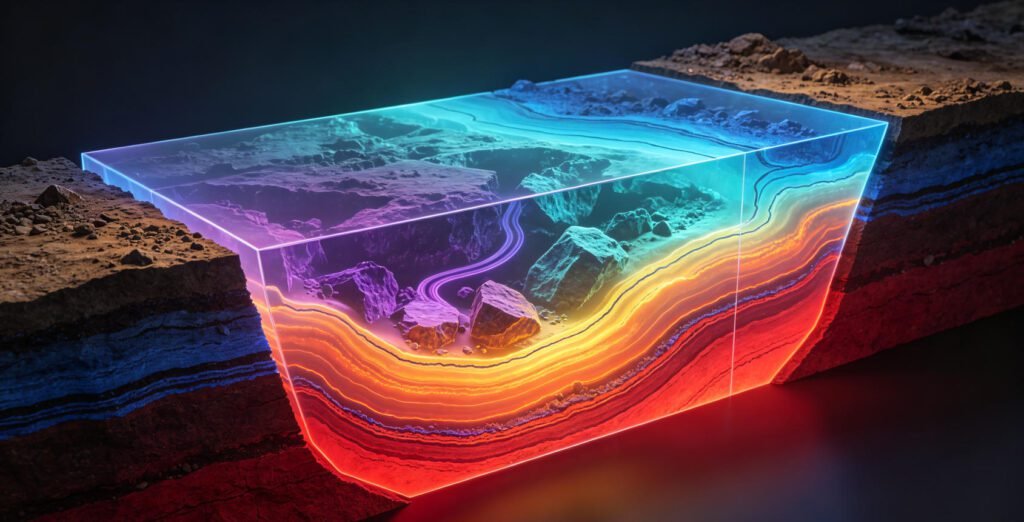
The transition from single-band to wideband MT is not merely incremental. It represents a fundamental shift in survey design philosophy. AI-enhanced interpretation platforms now process wideband datasets automatically. They classify geological features. They flag anomalies in near real-time.
Miniaturization and wireless telemetry further accelerate adoption. Lightweight wideband systems feature GNSS synchronization. They carry IP67 ratings. They operate in Arctic permafrost, tropical jungles, and high-altitude terrain.
The convergence of hardware versatility, software intelligence, and global exploration demand positions wideband MT as the default choice. It dominates serious deep exploration programs.
For teams still operating legacy single-band inventories, the business case is clear. One wideband MT instrument replaces multiple specialized units. It reduces capital expenditure. It simplifies training. It also delivers superior data products. As exploration targets move deeper and budgets tighten, wideband technology offers the only scalable path forward.
Ⅵ. Conclusion
Wideband MT instruments have moved from specialized research tools to standard field equipment. Their ability to capture full-spectrum electromagnetic data in a single deployment addresses the core inefficiency of single-band systems. That inefficiency is hardware fragmentation. Exploration teams gain continuous depth coverage. They achieve faster field operations. They also collect higher-quality datasets.
The market trajectory confirms this shift. Double-digit growth in MT survey contracts continues. Leading manufacturers maintain strong R&D investment. Wideband technology defines the current generation of deep exploration instruments.
For organizations evaluating their next geophysical investment, the decision is straightforward. A wideband MT instrument delivers more data. It provides deeper insight. It also offers lower total cost of ownership than any narrow-band alternative. The technology is mature. The applications are proven. The operational advantages are immediate.
Reference Sources
- ScienceDirect — Magnetotelluric Method Overview
https://www.sciencedirect.com/topics/earth-and-planetary-sciences/magnetotelluric-method - Oregon State University — National Geoelectromagnetic Facility
https://ngf.oregonstate.edu/node/3 - Geological Survey of Western Australia — MT Surveys
https://www.wa.gov.au/organisation/department-of-mines-petroleum-and-exploration/geological-survey-of-western-australia/magnetotelluric-mt-surveys - Dataintelo — MT System Market Report
https://dataintelo.com/report/magnetotelluric-mt-system-market - Dunn Hydrogeology — Audio-Magnetotelluric Surveying
https://www.dunnhydrogeo.com/home/audio-magnetotelluric-surveying-nt - Phoenix Geophysics — Company & Technology
https://www.phoenix-geophysics.com/
FAQ
What frequency range does a wideband MT instrument cover?
A wideband MT instrument typically spans from 10 kHz down to 0.00001 Hz (10,000 seconds). This range integrates audio magnetotellurics (AMT), broadband MT (BMT), and long-period MT into one continuous spectrum.
How deep can a wideband MT instrument detect?
Depth depends on ground conductivity and frequency. High frequencies resolve the first tens of meters. Low frequencies penetrate to crustal depths exceeding 10 km. A single wideband station can image from surface to mantle transition zones.
Why is wideband MT more efficient than single-band surveys?
Wideband MT eliminates hardware swaps between shallow and deep targets. One deployment captures all frequencies continuously. This reduces station time, crew size, and equipment logistics while improving data consistency.
What industries rely on deep exploration instruments like wideband MT?
Mining, geothermal energy, oil and gas, groundwater management, and environmental consulting all use wideband MT. The method serves any project requiring non-invasive resistivity imaging from near-surface to deep crustal depths.
Can wideband MT replace seismic surveys?
Wideband MT complements rather than replaces seismic. MT excels in conductive environments where seismic struggles, such as salt basins or volcanic terrains. Integrated interpretation using both methods yields the most reliable subsurface models.