Welcome to Geotech!
-1.png)

How OCXO Technology Enhances Accuracy in Portable Magnetic Gradiometers?
TIPS:OCXO technology delivers unmatched frequency stability for portable magnetic gradiometers. This guide explains how oven-controlled crystal oscillators enable proton magnetometers to achieve 0.01nT resolution in challenging field conditions. You will discover how OCXO technology eliminates temperature drift and why magnetic anomaly detection teams rely on proton magnetometer systems with OCXO cores for reliable geomagnetic survey results.
Ⅰ. Understanding OCXO Technology in Geomagnetic Survey Equipment
OCXO stands for Oven-Controlled Crystal Oscillator. It represents the gold standard for frequency stability. Geophysical instruments rely on precise timing. Magnetic field measurements demand exceptional accuracy.
1. What Is an Oven-Controlled Crystal Oscillator?
A crystal oscillator generates electrical signals at precise frequencies. Quartz crystals vibrate at predictable rates. Temperature changes alter these rates. Standard oscillators drift as conditions vary.
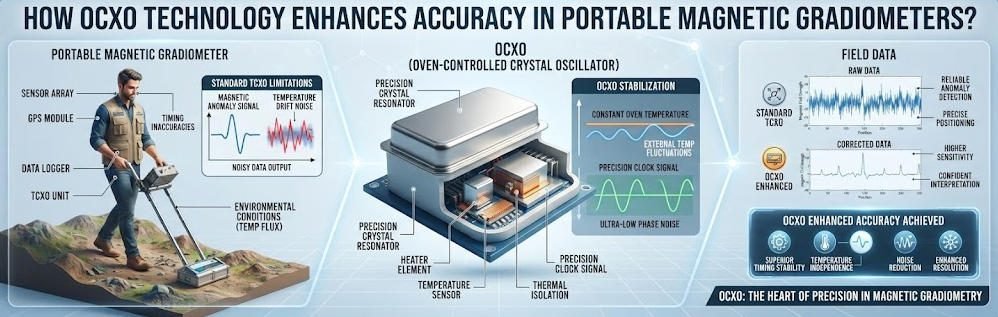
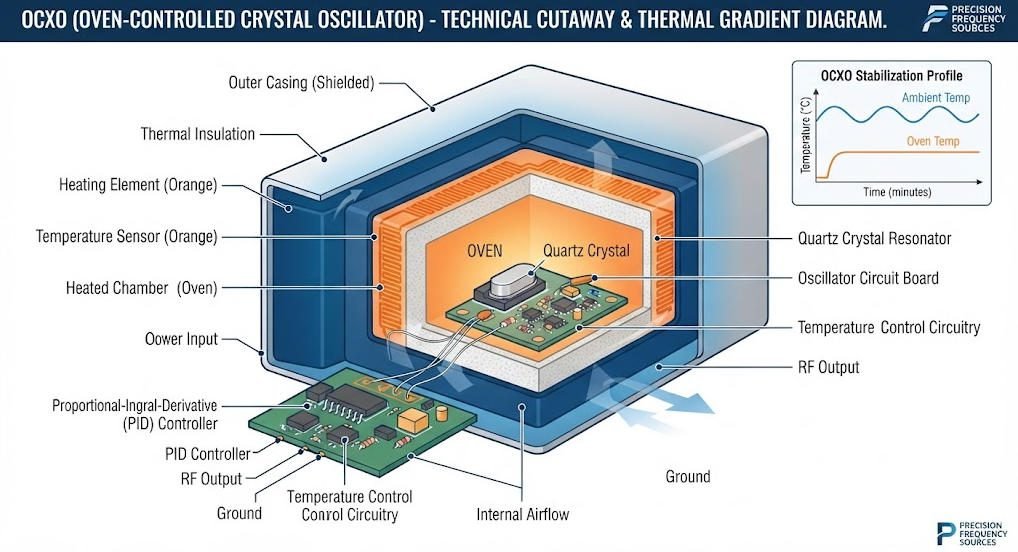
OCXO technology solves this problem. It houses the crystal in a heated chamber. The oven maintains constant temperature. Typical set points range from 75 to 85 degrees Celsius. This stability reduces frequency drift dramatically.
The result transforms magnetic measurements. Proton magnetometers count precession frequencies. These frequencies determine field strength. Stable counting yields accurate readings. OCXO cores enable 0.01nT resolution consistently.
2. Why Frequency Stability Matters for Magnetic Measurement
Proton precession magnetometers measure hydrogen atom spin rates. A polarizing current aligns proton spins. After polarization stops, protons precess around Earth’s field. The precession frequency follows the Larmor equation.
This frequency equals approximately 42.58 Hz per nanotesla. A 50,000 nT field produces about 2.13 MHz. Small frequency errors create large field errors. One hertz offset equals roughly 23.5 nanotesla.
Temperature affects oscillator frequency directly. Standard crystals drift several parts per million. This drift introduces unacceptable measurement errors. OCXO technology reduces drift below 0.01 parts per million.
3. Evolution from Standard Crystals to OCXO Cores
Early proton magnetometers used simple quartz oscillators. Field accuracy suffered in extreme climates. Desert surveys showed positive drift. Arctic measurements displayed negative bias.
Engineers added temperature compensation circuits. TCXO devices improved performance modestly. However, compensation could not match oven control. Residual errors remained significant.
OCXO technology emerged as the solution. Constant temperature eliminated drift sources. Modern units maintain stability across -40 to +55 degrees Celsius. This range covers all operational environments.
Ⅱ. How OCXO Technology Enhances Portable Magnetic Gradiometers
Portable magnetic gradiometers measure field differences between two sensors. They detect subtle anomalies beneath the surface. OCXO technology improves every aspect of this measurement.
1. Temperature Compensation in Extreme Environments
Field surveys encounter wide temperature ranges. Morning chill gives way to midday heat. Desert surfaces exceed 60 degrees Celsius. Mountain tops drop below freezing.
Standard oscillators drift under these conditions. A 0.1 parts per million shift equals 2.3 nanotesla error. Such errors mask genuine anomalies. Survey quality degrades significantly.
OCXO technology maintains constant crystal temperature. The oven consumes minimal power. It stabilizes within minutes of startup. Field teams achieve consistent accuracy regardless of weather.
2. Microsecond-Level Timing Synchronization
Modern surveys use multiple instruments simultaneously. Base stations record diurnal variations. Mobile units traverse survey lines. Data merging requires precise time alignment.
OCXO cores enable GPS and BeiDou multi-mode timing. Synchronization accuracy reaches one microsecond. This precision ensures proper diurnal correction. Survey data align perfectly across instruments.
Oscillator stability below 5 times 10 to the minus 9 limits frequency error. Over ten-second measurement cycles, error stays below 0.001 hertz. This translates to 0.023 nanotesla field uncertainty.
3. Noise Reduction and Signal Clarity
Electromagnetic noise plagues magnetic surveys. Power lines create strong interference. Vehicle engines generate magnetic clutter. Urban environments prove particularly challenging.
OCXO stability improves signal-to-noise ratios. Consistent frequency counting reduces jitter. Clean reference signals enhance detection thresholds. Weak anomalies become visible against background noise.
Dual-coil reverse-series probe designs complement OCXO cores. External interference induces opposing currents. These currents cancel before reaching the sensor. Under 500-volt power lines, single-coil signal-to-noise ratio drops to 3. Dual-coil mode maintains ratio at 9.
Ⅲ. Technical Comparison: OCXO vs Traditional Oscillators
Understanding performance differences guides instrument selection. This section compares key specifications.
1. Standard Crystal Oscillator Limitations
Standard crystals exhibit significant temperature coefficients. Frequency shifts approximately 20 parts per million across operational ranges. For magnetic measurement, this creates large errors.
Consider a typical survey scenario. Morning temperature reads 10 degrees Celsius. Afternoon peaks at 35 degrees. A 25-degree swing shifts frequency by 0.5 parts per million. This equals 11.5 nanotesla apparent field change.
Such changes exceed many geological anomalies. Small ore bodies may produce only 5 nanotesla signals. Temperature drift completely masks these features. Surveyors miss valuable targets.
2. TCXO Performance Characteristics
Temperature-Compensated Crystal Oscillators improve on standard designs. Internal circuits adjust frequency actively. Compensation reduces drift to about 1 part per million.
This improvement helps moderately. Remaining errors still reach 23 nanotesla. Many applications require better performance. TCXO devices suit less demanding magnetic surveys.
Power consumption remains lower than OCXO units. Battery life extends slightly. Cost savings attract budget-conscious buyers. However, precision-critical projects need more.
3. OCXO Superiority in Magnetic Applications
OCXO technology achieves unmatched stability. Frequency drift stays below 0.01 parts per million. Equivalent magnetic error remains under 0.23 nanotesla. This precision transforms survey capabilities.
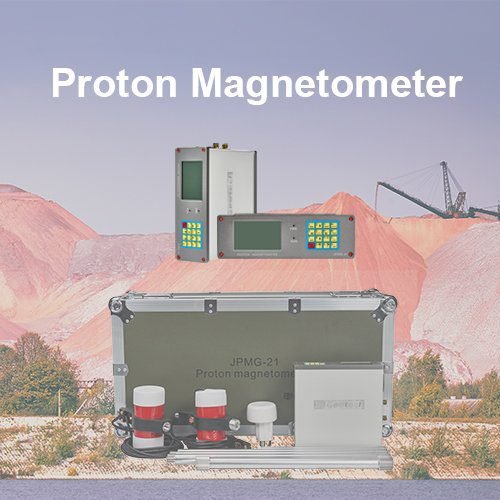
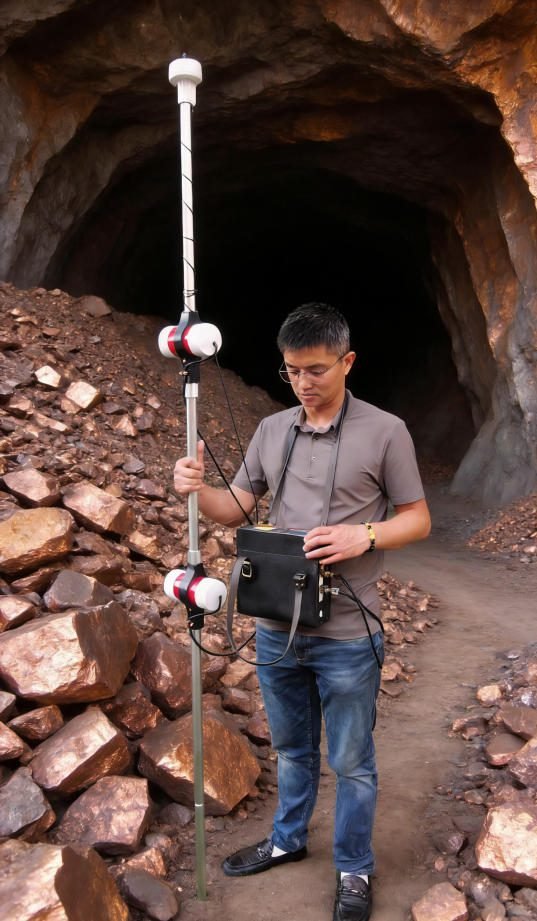
The JPMG Series proton magnetometer demonstrates these benefits. Absolute accuracy reaches plus or minus 0.1 nanotesla. Resolution hits 0.01 nanotesla. Gradient tolerance exceeds 5000 nanotesla per meter.
Field tests confirm laboratory specifications. Olary Iron Project surveys completed 22 percent faster. Twelve mineralized zones emerged clearly. Three previously unknown fault lines appeared. Traditional instruments missed these features.
Ⅳ. Applications of OCXO-Enhanced Magnetic Gradiometers
Precision magnetometers serve diverse industries. OCXO technology expands application possibilities.
1. Mineral Exploration and Mining
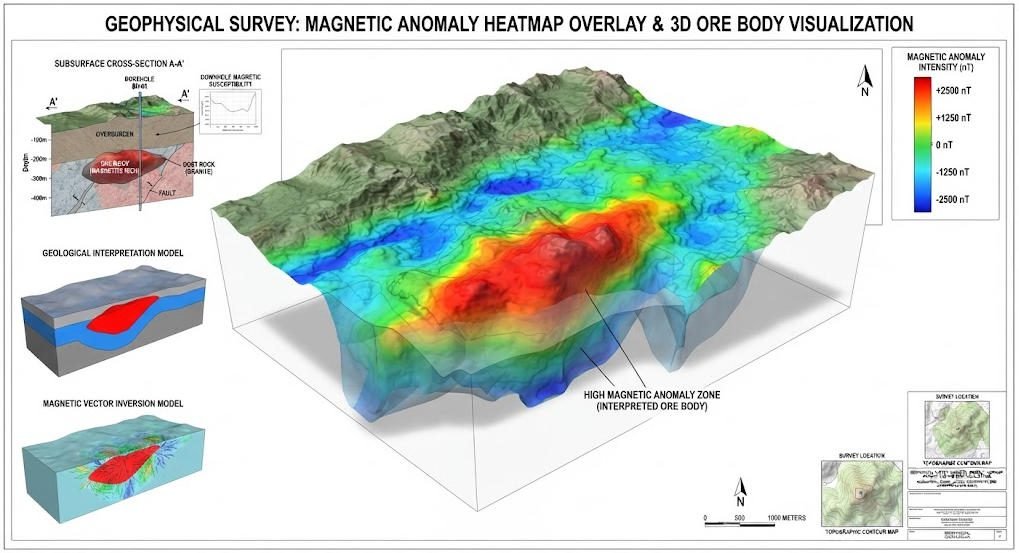
Iron ore deposits create strong magnetic signatures. Magnetite alters local fields dramatically. Proton magnetometers map these changes efficiently. OCXO precision reveals subtle extensions.
The Olary Iron Project in South Australia illustrates this power. Survey teams deployed JPMG Series instruments. OCXO stability enabled rapid data acquisition. Results identified new ore zones quickly.
Base metal deposits also produce magnetic responses. Pyrrhotite accompanies many lead-zinc systems. Copper porphyries show characteristic patterns. High-precision surveys distinguish economic mineralization.
2. Archaeological Research
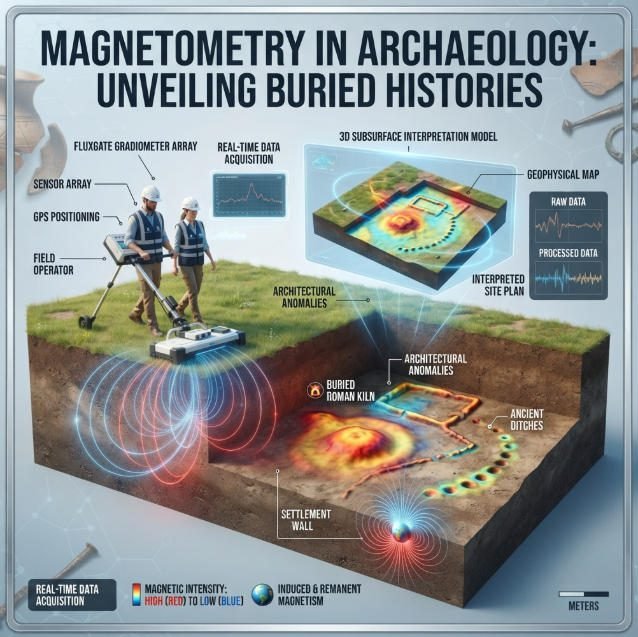
Buried structures alter soil magnetism. Fired clay becomes more magnetic. Foundation trenches fill with topsoil. These changes create detectable anomalies.
Brazilian archaeologists mapped twelfth-century settlements. JPMG Series instruments detected artifacts at 2.3 meters depth. Non-invasive survey preserved site integrity. Excavation targeted productive zones precisely.
OCXO precision proved essential. Weak cultural signals measured only a few nanotesla. Temperature drift would obscure these features. Stable oscillators revealed settlement patterns clearly.
3. Environmental Monitoring
Underground pipelines create linear anomalies. Steel pipes distort local magnetic fields. Magnetometers trace pipeline routes accurately. This capability supports urban planning.
Environmental engineers monitor contamination plumes. Magnetic minerals indicate pollutant migration. High-resolution surveys track changes over time. OCXO stability enables reliable time-lapse studies.
Geothermal projects benefit similarly. Hot fluids alter rock magnetism. Repeated surveys monitor reservoir changes. Stable instruments ensure meaningful comparisons.
4. Engineering Geology and Infrastructure
Foundation studies require bedrock mapping. Magnetic surveys identify weathering zones. Engineers avoid unstable ground. Construction costs reduce significantly.
Tunnel projects use magnetic data. Fault zones display characteristic signatures. Advance knowledge improves safety. OCXO precision guides critical decisions.
Dam monitoring employs repeated surveys. Seepage changes alter local magnetism. Early detection prevents catastrophic failures. Instrument stability ensures trend reliability.
Ⅴ. Data Analysis: Forward and Inverse Modeling
Raw magnetic data require interpretation. Mathematical models convert measurements into geological understanding. OCXO precision improves every modeling stage.
1. Forward Modeling Applications
Forward modeling predicts magnetic responses. Geologists propose subsurface structures. Computers calculate expected fields. Comparisons with measured data test hypotheses.
Accurate predictions require precise field measurements. OCXO stability ensures reliable input data. Small errors propagate through calculations. Stable instruments reduce modeling uncertainty.
Software packages automate these processes. Three-dimensional models simulate complex geology. Magnetic susceptibility distributions create synthetic responses. Matching algorithms optimize parameter selection.
2. Inverse Modeling and Interpretation
Inverse modeling derives structure from data. Algorithms find geological models matching measurements. This process solves ill-posed mathematical problems. Multiple solutions often exist.
High-quality data constrain solutions better. OCXO precision reduces measurement scatter. Tighter constraints yield more reliable interpretations. Geologists trust conclusions more confidently.
Regularization techniques stabilize inversions. Smoothness constraints eliminate unrealistic models. Depth weighting compensates for signal decay. Combined approaches produce geologically reasonable results.
3. Integration with Other Geophysical Methods
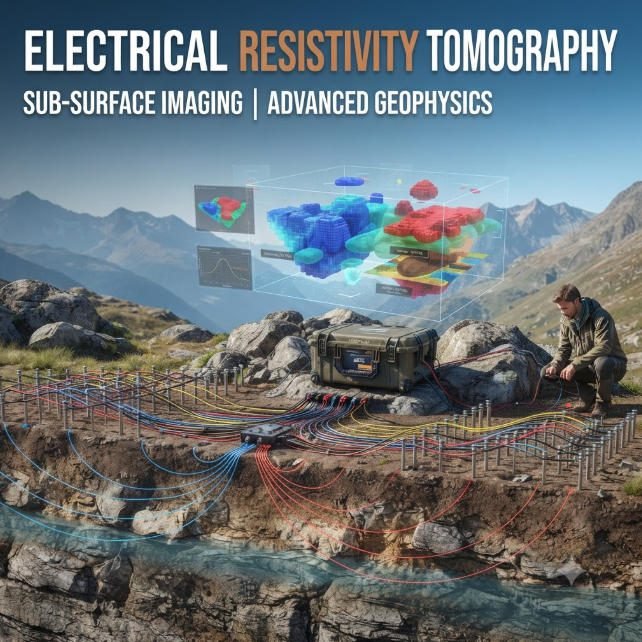
Magnetic data alone provide limited information. Integration with other methods strengthens interpretation. Gravity surveys add density constraints. Electrical methods reveal conductivity variations.
Seismic data define structural geometry. Joint inversion combines multiple datasets. Physical property relationships link different responses. OCXO-enhanced magnetometers contribute critical magnetic constraints.
Ⅵ. Magnetic Anomaly Detection with OCXO Stability
Magnetic anomaly detection represents the core purpose of geomagnetic surveys. OCXO technology directly improves detection capabilities.
1. Detecting Weak Anomalies
Many economically important targets produce weak signals. Disseminated sulfides create subtle responses. Alteration halos around ore bodies show low contrast. Deeply buried features attenuate significantly.
Portable magnetic gradiometers with OCXO cores detect these weak anomalies. Stable baselines reveal small deviations. Noise floors drop below 0.1 nanotesla. Previously invisible features emerge clearly.
2. Mapping Complex Geometries
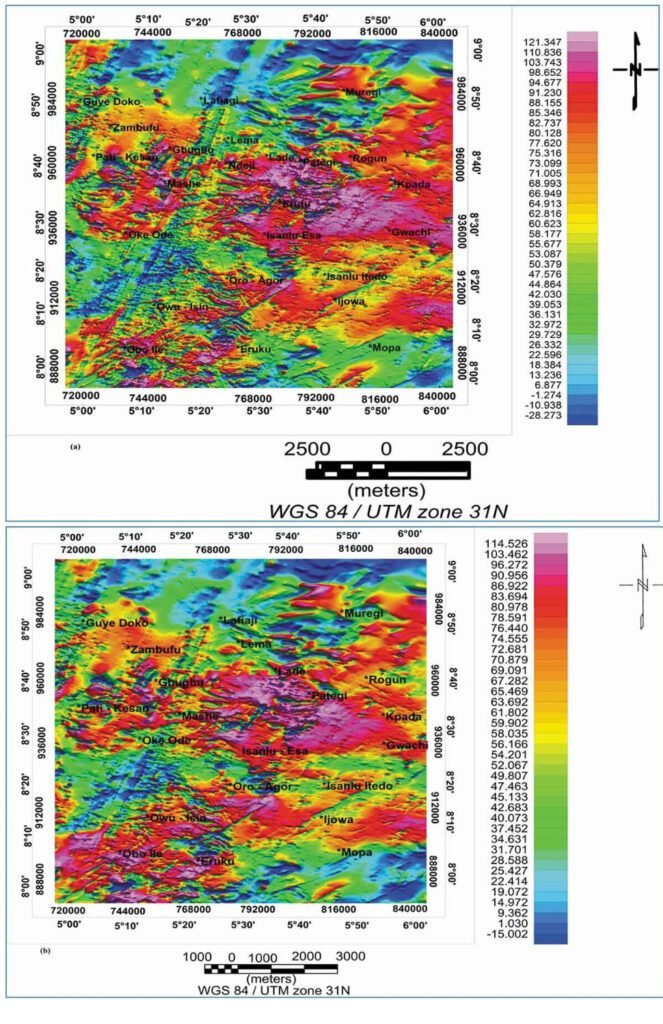
Geological structures rarely follow simple shapes. Folded strata create complex patterns. Fault offsets displace anomalies. Igneous intrusions produce irregular signatures.
High-precision data capture these complexities. Dense survey grids sample fields adequately. OCXO stability ensures point-to-point consistency. Resulting maps show true geological complexity.
3. Time-Lapse Monitoring
Some applications require repeated measurements. Reservoir monitoring tracks fluid movement. Volcanic surveillance detects magma changes. Environmental remediation verifies contaminant removal.
Time-lapse magnetic anomaly detection demands exceptional stability. Instruments must repeat measurements exactly. OCXO technology provides this repeatability. Subtle changes become detectable over time.
Ⅶ. Selecting OCXO-Enhanced Geomagnetic Survey Equipment
Choosing appropriate instruments ensures project success. Consider these factors carefully.
1. Resolution and Accuracy Requirements
Project objectives define instrument specifications. Reconnaissance surveys tolerate moderate precision. Detailed investigations demand highest accuracy. Define target anomaly amplitudes clearly.
The JPMG Series offers 0.01 nanotesla resolution. This sensitivity detects subtle features. Absolute accuracy of 0.1 nanotesla supports quantitative analysis. Specify requirements before purchasing.
2. Environmental Operating Range
Consider typical field conditions. Arctic projects face extreme cold. Desert surveys endure intense heat. Tropical environments combine heat with humidity.
OCXO technology handles these extremes. Verify specified temperature ranges. The JPMG Series operates from -40 to +55 degrees Celsius. Humidity ratings matter for tropical work.
3. Portability and Power Consumption
Field weight affects daily productivity. Heavy instruments fatigue operators. Battery life limits survey duration. Balance performance against portability.
Modern OCXO units minimize power draw. Efficient ovens reach stable temperature quickly. Low-power designs extend battery operation. Single-person surveys become practical.
4. Data Management and Software Support
Field computers store survey results. GPS integration records positions automatically. Post-processing software creates maps and profiles. Evaluate software capabilities thoroughly.
Data export formats affect workflow compatibility. Industry-standard formats simplify integration. Technical support availability matters for complex projects. Training resources accelerate operator proficiency.
Ⅷ. Future Trends in OCXO Technology and Magnetic Sensing
Technology continues advancing rapidly. Several trends shape future development.
1. Miniaturization and Integration
Electronics shrink continuously. Future OCXO units will fit smaller packages. MEMS technology offers interesting possibilities. Micro-ovens may replace traditional designs.
Integration with smartphone platforms emerges. Wireless data transmission simplifies logistics. Cloud processing reduces field computer requirements. These trends democratize high-precision surveying.
2. Multi-Sensor Fusion
Combined instruments gather diverse data. Magnetometers pair with gamma spectrometers. Radiometric information complements magnetic signatures. Integrated units reduce field time.
Drone-mounted systems expand coverage. Aerial magnetic surveys access remote areas. OCXO stability ensures data quality during flight. Automated processing accelerates result delivery.
3. Artificial Intelligence in Data Processing
Machine learning automates anomaly detection. Neural networks recognize feature patterns. They flag interesting zones for human review. Processing speed increases dramatically.
AI also optimizes survey design. Algorithms predict optimal line spacing. They estimate detection probabilities. These tools improve project planning efficiency.
4. Enhanced Temperature Ranges
Future OCXO devices may operate in wider ranges. Cryogenic applications demand extreme cold performance. Geothermal surveys encounter high temperatures. Advanced materials enable broader specifications.
Power efficiency improvements extend battery life. Solar charging supports extended surveys. Energy harvesting from operator motion offers intriguing possibilities.

Ⅸ. Conclusion
OCXO technology revolutionizes portable magnetic gradiometers. Oven-controlled crystal oscillators eliminate temperature-related drift. Proton magnetometers achieve unprecedented field precision. Survey teams worldwide benefit from this innovation.
The JPMG Series from Geotech Instrument demonstrates these advantages. Absolute accuracy reaches 0.1 nanotesla. Resolution hits 0.01 nanotesla. Gradient tolerance exceeds 5000 nanotesla per meter.
Applications span mineral exploration, archaeology, and environmental monitoring. Engineering geology and infrastructure projects benefit equally. Forward and inverse modeling rely on precise input data. Magnetic anomaly detection reaches new sensitivity levels.
Geotech continues advancing geomagnetic survey equipment. Our engineering team develops innovative solutions. We support projects from instrument selection through data interpretation. Contact our specialists to discuss your magnetic survey requirements.
OCXO technology represents more than incremental improvement. It enables measurements previously considered impossible. Embrace this technology for superior geophysical results.
Reference Sources
| Organization | URL |
|---|---|
| Society of Exploration Geophysicists (SEG) | https://seg.org/ |
| International Association of Geomagnetism and Aeronomy (IAGA) | https://www.iaga-aiga.org/ |
| US Geological Survey (USGS) – Geomagnetism Program | https://geomag.usgs.gov/ |
| British Geological Survey (BGS) – Geomagnetism | https://www.bgs.ac.uk/geology-projects/geomagnetism/ |
| European Association of Geoscientists & Engineers (EAGE) | https://www.eage.org/ |
FAQ
Q1: What is OCXO technology in proton magnetometers?
A1: OCXO technology uses an oven-controlled crystal oscillator to maintain constant temperature. This eliminates frequency drift caused by temperature changes. Proton magnetometers with OCXO cores achieve 0.01nT resolution. The JPMG Series demonstrates this precision in field conditions.
Q2: Why does temperature affect magnetic gradiometer accuracy?
A2: Temperature changes alter crystal oscillator frequency. Standard crystals drift several parts per million. This creates magnetic errors exceeding 2 nanotesla. OCXO technology maintains constant crystal temperature. It reduces drift below 0.01 parts per million.
Q3: What applications benefit most from OCXO-enhanced magnetometers?
A3: Mineral exploration detects subtle ore zones. Archaeological surveys map buried structures non-invasively. Environmental monitoring tracks contamination. Engineering geology assesses foundation stability. All benefit from OCXO precision.
Q4: How does a portable magnetic gradiometer work?
A4: It measures magnetic field differences between two sensors. Proton precession in hydrogen-rich fluid creates measurable signals. OCXO-stabilized oscillators count precession frequencies accurately. Software converts data into anomaly maps.
Q5: What specifications should I look for in geomagnetic survey equipment?
A5: Resolution of 0.01nT detects subtle anomalies. Absolute accuracy within 0.1nT supports quantitative work. Temperature range from -40 to +55°C covers all environments. Gradient tolerance above 5000nT/m handles complex terrain.