Welcome to Geotech!



Services

Principles and Simulation Experiments of Potential Measurement Method
TIPS:Electrical resistivity method and induced polarization method form the foundation of geophysical electrical exploration. This guide explains how electrical resistivity method detects subsurface structures through current injection. You will learn induced polarization method principles for mineral discrimination. We compare electrode…
Basic principles and applications of geophysical exploration
TIPS:The high-density electrical resistivity method is an advanced geophysical technique that creates detailed 2D and 3D images of subsurface electrical properties. Also called electrical resistivity tomography (ERT), this method deploys dozens to hundreds of electrodes in automated arrays. It measures…
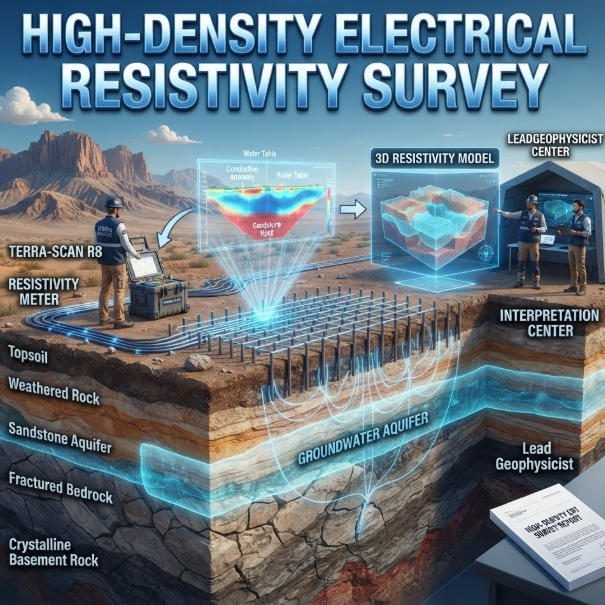
Principle of High-Density Electrical Resistivity Survey and Case Analysis
TIPS:High-density electrical resistivity surveys reveal underground structures without drilling. This guide explains how high-density electrical resistivity works in karst detection, mining void surveys, and engineering geology. You will learn field deployment tactics, WGMD-4 system specs, and how Geotech interprets resistivity…
ERT and TDIP/IP: A Complete Technical Guide
TIPS:Electrical Resistivity Tomography (ERT) and Time-Domain Induced Polarization (TDIP/IP) are two complementary geophysical methods that map subsurface electrical properties in 2D and 3D. ERT measures how rocks and soils resist electrical current flow. TDIP captures the delayed voltage response after…
What is Vertical Electrical Sounding (VES)?
Vertical Electrical Sounding (VES) is a foundational geophysical technique that measures how electrical resistivity changes with depth beneath a single surface point. Also called electrical resistivity sounding, VES uses four-electrode arrays—most commonly the Schlumberger configuration—to build a 1D layered model…