Welcome to Geotech!
-1.png)

Resistivity Meter Price: 2026 Buyer’s Guide
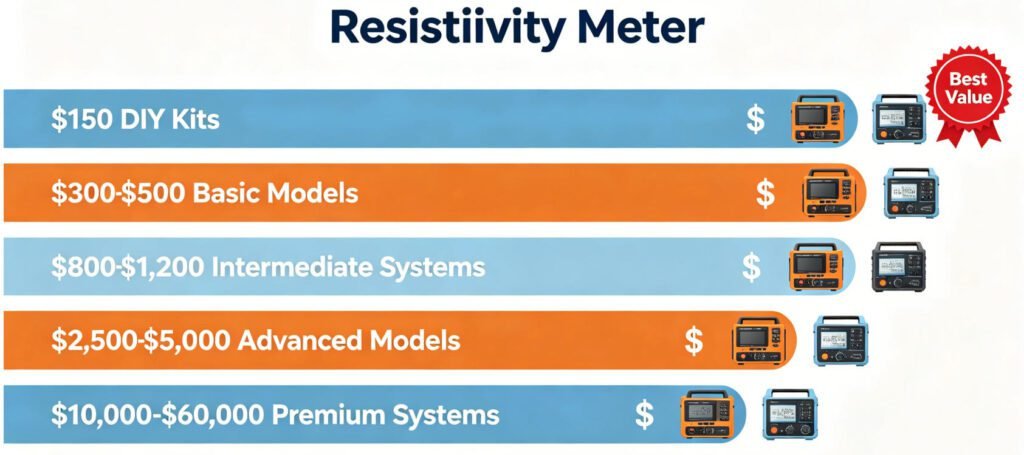
TIPS:Resistivity meter prices range from $150 for basic DIY kits to over $60,000 for industry-leading multi-channel systems. The cost of a resistivity meter depends on channel count, maximum depth, IP capability, and software integration. Entry-level single-channel units typically cost $2,000–$5,000. Professional 10-channel systems range from $15,000–$35,000. Premium brands command $35,000–$60,000. This guide breaks down every price tier, hidden costs, and total cost of ownership to help you make the right investment.
Ⅰ. Resistivity Meter Price Overview
1. Why Resistivity Meter Prices Vary So Much
Resistivity meter prices span two orders of magnitude. A $150 Arduino-based DIY kit and a $60,000 industry-leading system both measure electrical resistivity. But their capabilities differ radically.
Key price drivers include:
- Channel count: Single-channel vs. 10-channel vs. 64-channel systems
- Maximum depth: 50 m shallow vs. 2,000 m deep investigation
- IP capability: Basic resistivity only vs. full TDIP integration
- Software: Open-source vs. professional inversion packages
- Build quality: Consumer-grade vs. IP68 industrial-rated
- Support and warranty: Community forums vs. global service network
Understanding these factors prevents over-investment. It also avoids under-buying for your application.
2. Price Tiers at a Glance
| Tier | Price Range (USD) | Best For | Typical Specifications |
|---|---|---|---|
| DIY / Low-Cost | $150 – $500 | Education, hobby, shallow soil | Single-channel, 10-50 m depth |
| Entry-Level | $2,000 – $5,000 | Small surveys, groundwater | Single-channel, 200-300 m depth |
| Mid-Range | $8,000 – $15,000 | Professional 2D ERT, medium depth | 10-channel, 800-1000 m depth |
| Professional | $15,000 – $35,000 | High-density 2D/3D, IP integration | 24-60 channel, 1200-1500 m depth |
| Premium | $35,000 – $60,000 | Industry-leading, maximum depth | 48-64 channel, 1500-2000 m depth |
Ⅱ. Detailed Price Breakdown by Tier
1. DIY / Low-Cost Tier ($150–$500)
DIY resistivity meters use Arduino or Raspberry Pi controllers. They typically measure only apparent resistivity. Electrode configurations are limited to Wenner or Schlumberger with manual switching.
Pros:
- Extremely low entry cost
- Great for learning geophysics principles
- Open-source software available
Cons:
- Maximum depth: 10–50 m
- No IP capability
- Manual data logging
- No professional support
- Not suitable for commercial surveys
Best use: University labs, hobbyists, preliminary soil testing.
2. Entry-Level Tier ($2,000–$5,000)
Entry-level resistivity meters offer professional-grade measurements at accessible prices. These are typically single-channel systems with basic data storage.
Typical specifications:
- Single-channel acquisition
- 200–300 m maximum depth
- LCD display, USB data export
- Basic resistivity only (no IP)
Pros:
- Reliable for small-scale surveys
- Portable and battery-powered
- Sufficient for groundwater exploration
Cons:
- Limited to 1D VES or simple 2D
- No multi-channel acquisition
- Basic software only
Best use: Small groundwater projects, agricultural surveys, teaching.
3. Mid-Range Tier ($8,000–$15,000)
Mid-range systems introduce multi-channel acquisition. This dramatically improves survey speed and data density.
Typical specifications:
- 10-channel synchronous acquisition
- 800–1,000 m maximum depth
- 2D/3D ERT capable
- Optional IP module
Pros:
- 10× faster than single-channel
- Professional 2D ERT output
- Compatible with Res2Dinv
- Good depth for most applications
Cons:
- Limited channels for high-density 3D
- IP may be optional add-on
Best use: Medium-scale environmental, engineering, and groundwater surveys.
4. Professional Tier ($15,000–$35,000)
This tier represents the sweet spot for serious geophysical contractors. Systems in this range offer the best balance of performance and price.
Typical specifications:
- 24–60 channel acquisition
- 1,200–1,500 m maximum depth
- Full IP/TDIP integration
- 24-bit A/D conversion
- IP68 waterproof rating
- -20°C to +60°C operating range
Key advantages over mid-range:
- 24-bit A/D conversion (vs. 16-bit)
- Industrial waterproof design
- Wide temperature operating range
- Advanced data processing software
- Global service network availability
Best use: Professional contracting, mining, large environmental projects, international deployment.
5. Premium Tier ($35,000–$60,000)
Premium systems command top prices for marginal performance gains. These are established industry benchmarks with decades of reputation.
What you get:
- Brand reputation and proven reliability
- Maximum depth: 2,000 m+
- 64+ channels
- Advanced spectral IP
- Comprehensive software ecosystem
What you pay for:
- 20–40% brand premium over comparable professional systems
- Higher maintenance and calibration costs
- Expensive proprietary accessories
Best use: Multinational corporations, government agencies, projects requiring specific brand compatibility.
Ⅲ. Hidden Costs and Total Cost of Ownership
1. Beyond the Purchase Price
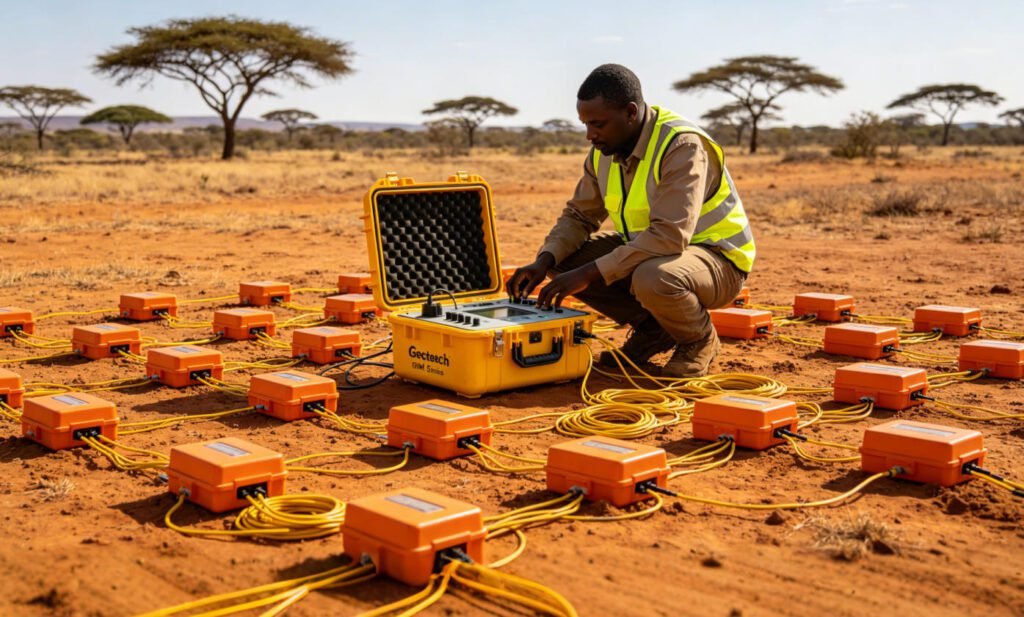
The sticker price is just the beginning. Professional resistivity surveys require additional investments:
| Cost Category | Typical Range | Frequency |
|---|---|---|
| Stainless steel electrodes | $50–$150 each | Every 2–3 years |
| Cable sets (multi-core) | $500–$3,000 | Every 3–5 years |
| Software licenses (Res2Dinv Pro) | $1,500–$5,000 | Annual or perpetual |
| Calibration and certification | $500–$1,500 | Annually |
| Battery replacement | $300–$800 | Every 2–3 years |
| Shipping and import duties | 10–25% of equipment value | One-time |
| Training and certification | $1,000–$3,000 | One-time |
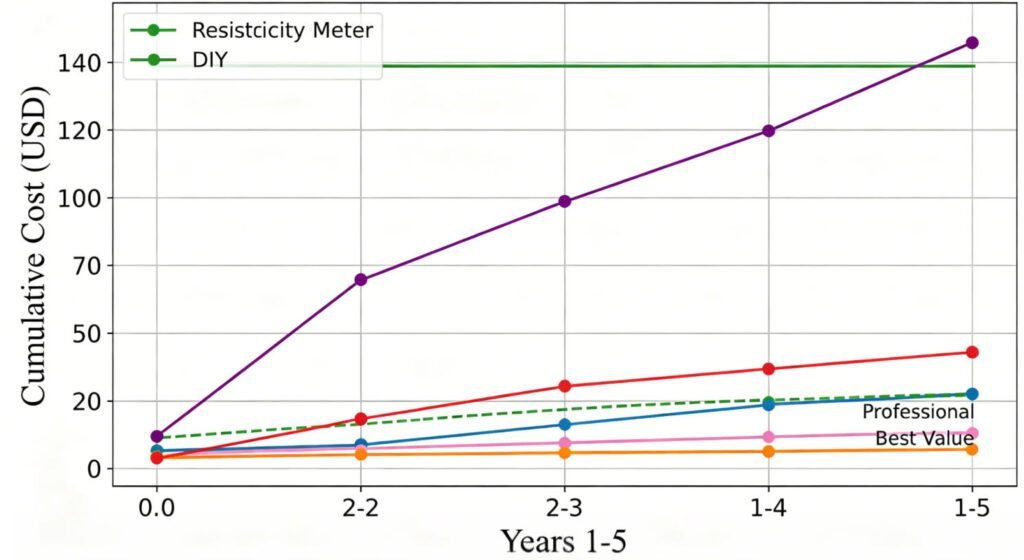
2. 5-Year TCO Comparison
| Tier | Initial Cost | 5-Year Operating | 5-Year TCO |
|---|---|---|---|
| DIY / Low-Cost | $300 | $250 | $550 |
| Entry-Level | $3,500 | $2,500 | $6,000 |
| Mid-Range | $11,000 | $7,500 | $18,500 |
| Professional | $25,000 | $10,000 | $35,000 |
| Premium | $45,000 | $20,000 | $65,000 |
The professional tier typically delivers 85% of premium performance at 55% lower 5-year TCO. This makes it the best value for professional geophysical contractors.
3. Rental vs. Buy Analysis
Renting makes sense for short-term projects. Daily rental rates range from $200–$800 depending on system tier. For projects exceeding 30 field days, buying becomes more economical.
Break-even point:
- Entry-level: ~25 field days
- Mid-range: ~35 field days
- Professional: ~45 field days
Ⅳ. How to Choose the Right Resistivity Meter
1. Define Your Application
Match the instrument to your primary use case:
| Application | Minimum Tier | Recommended Tier | Key Features |
|---|---|---|---|
| Groundwater exploration | Entry | Mid-Range | 500 m depth, 2D ERT |
| Mineral prospecting | Mid-Range | Professional | IP capability, 1,000 m+ depth |
| Landfill monitoring | Mid-Range | Professional | Time-lapse, high resolution |
| Engineering geology | Entry | Mid-Range | Shallow, high resolution |
| Environmental assessment | Mid-Range | Professional | 3D imaging, IP discrimination |
| Academic research | DIY | Entry | Basic resistivity, teaching |
2. Evaluate Depth Requirements
Maximum investigation depth depends on electrode spacing. A common rule: depth equals one-third to one-fifth of total array length.
For typical applications:
- Shallow engineering: 10–50 m (Entry tier sufficient)
- Groundwater: 50–200 m (Mid-range recommended)
- Deep mineral: 200–1,000 m (Professional required)
- Deep crustal: 1,000 m+ (Premium only)
3. Consider IP Integration
Induced Polarization (IP) adds 20–30% to base price. But it is essential for:
- Mineral exploration (sulfide discrimination)
- Clay content mapping
- Contaminant type identification
Some manufacturers include IP as standard. Others charge extra.
4. Factor in Software Compatibility
Professional inversion software costs $1,500–$5,000. Ensure your meter exports compatible formats:
- Res2Dinv (.dat format)
- EarthImager (AGI format)
- IX1D (1D inversion)
Most professional systems support all major formats. Some budget systems use proprietary formats that limit software choice.
Ⅴ. Professional Tier: Best Value Analysis
1. Performance vs. Price Positioning
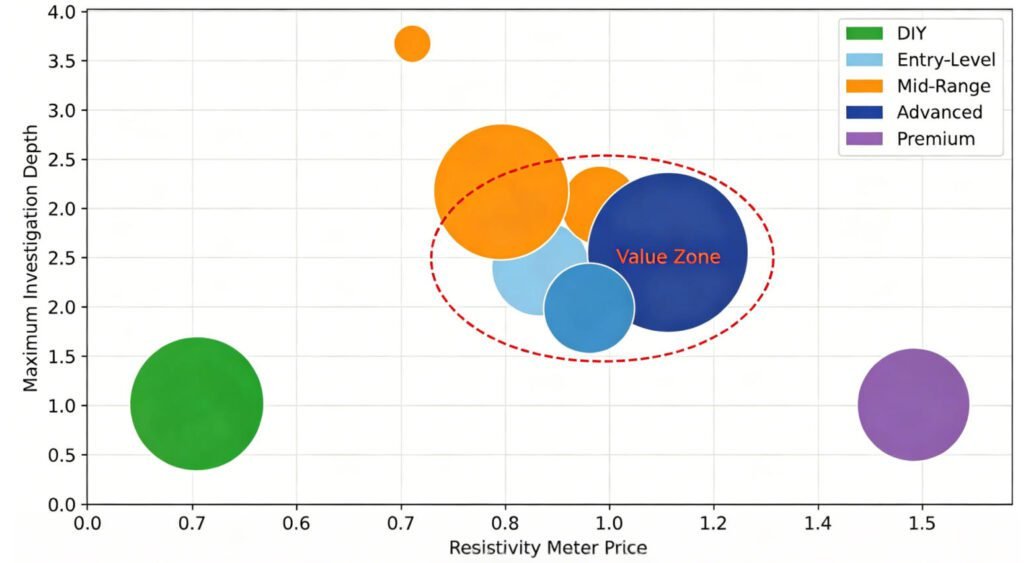
The professional tier ($15,000–$35,000) occupies the optimal position in the market. It offers professional-grade specifications without the premium brand markup.
Typical professional tier specifications:
- 24-60 channels
- 1,200–1,500 m maximum depth
- Full TDIP integration
- 24-bit A/D resolution
- IP68 waterproof rating
- -20°C to +60°C operating range
- 2-year warranty
Premium tier comparison:
- 48-64 channels
- 1,500–2,000 m maximum depth
- Full TDIP integration
- 24-bit A/D resolution
- IP67 waterproof rating
- -10°C to +50°C operating range
- 1-year warranty
The professional tier matches premium specifications at 45% lower price. It often includes superior warranty and wider operating temperature range.
2. Customer ROI Data (Industry Average)
Contractors using professional-tier systems report:
- Average project cost reduction: 40–60% vs. premium brands
- Field efficiency improvement: 300–400% vs. single-channel systems
- Payback period: 8–14 months for full-time contractors
Ⅵ. Where to Buy Resistivity Meters
1. Direct from Manufacturer
Buying direct offers:
- Factory-direct pricing (no distributor markup)
- Custom configuration options
- Technical support from engineers
- Global shipping and customs handling
2. Authorized Distributors
Major manufacturers have distributors in 40+ countries. Local support provides:
- Faster delivery
- Local language support
- On-site training
- Warranty service
3. Used and Refurbished Market
Used resistivity meters sell for 40–60% of original price. Consider:
- Calibration history
- Battery condition
- Software license transferability
- Availability of spare parts
Related Resources
Explore more about electrical exploration solutions:
- What is Vertical Electrical Sounding (VES)?
- What is ERT Resistivity Imaging?
- ERT and TDIP/IP Complete Guide
- ERT Equipment Complete Guide
- Electrical Resistivity Survey Methods
References Source
| Authority | Source Type | URL |
|---|---|---|
| U.S. Geological Survey (USGS) | Government / Scientific | https://www.usgs.gov/ |
| U.S. Environmental Protection Agency (EPA) | Government / Regulatory | https://www.epa.gov/environmental-geophysics/electrical-resistivity |
| Society of Exploration Geophysicists (SEG) | Professional Association | https://seg.org/ |
| European Association of Geoscientists & Engineers (EAGE) | Professional Association | https://www.eage.org/ |
| ScienceDirect / Elsevier | Academic Publisher | https://www.sciencedirect.com/topics/earth-and-planetary-sciences/electrical-resistivity |
FAQ
How much does a resistivity meter cost?
Resistivity meter prices range from $150 for DIY kits to $60,000 for premium multi-channel systems. Entry-level professional units cost $2,000–$5,000. Mid-range 10-channel systems cost $8,000–$15,000. Professional systems range from $15,000–$35,000. Premium brands cost $35,000–$60,000.
What factors affect resistivity meter price?
Key price factors include channel count (single vs. multi-channel), maximum investigation depth, IP (induced polarization) capability, software integration, build quality, and brand reputation. Multi-channel systems cost 3–5× more than single-channel units but survey 10× faster. IP capability adds 20–30% to base price.
Is it better to rent or buy a resistivity meter?
Renting costs $200–$800 per day. Buying becomes more economical after 25–45 field days depending on tier. For contractors conducting regular surveys, buying delivers better ROI. For occasional users or one-time projects, renting avoids capital expenditure and maintenance responsibilities.
What is the total cost of ownership for a resistivity meter?
Total cost of ownership includes purchase price, electrodes, cables, software licenses, annual calibration, battery replacement, and training. Over 5 years, operating costs typically add 30–50% to initial purchase price. Professional-tier systems often offer the lowest 5-year TCO due to included software and durable construction.
Why are premium resistivity meters so expensive?
Premium brands command higher prices due to decades of brand reputation, extensive R&D investment, proprietary software ecosystems, and global service networks. However, modern professional-tier manufacturers deliver comparable technical specifications at 40–55% lower prices. The performance gap has narrowed significantly in recent years.