Welcome to Geotech!
-1.png)


What Is the Price of a Resistivity Meter? A Practical Buying Guide
Overview:The Resistivity Meter Price depends on the measurement method, channel capacity, output capability, and included accessories. A basic instrument may serve simple measurements, while professional ERT and IP systems require more advanced acquisition and processing capabilities. This guide explains the Electrical Resistivity Meter Cost, compares equipment categories, and outlines the factors that influence total project spending.
Ⅰ. How Much Does a Resistivity Meter Cost?
1. Quick Answer: Resistivity Meter Price
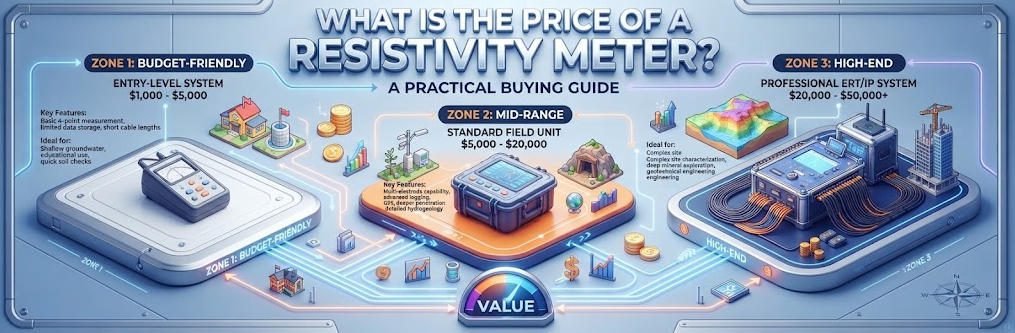
A resistivity meter can cost from a few hundred dollars for a basic or experimental instrument to tens of thousands of dollars for a professional geophysical survey system. The price depends on the measurement method, system configuration, channel capacity, IP capability, software, and included accessories.
For a practical budget, distinguish between a basic resistance or soil-resistivity instrument and a professional geophysical system designed for subsurface investigation.
Public listings illustrate this wide range. A commercial analog soil-resistivity meter is listed at approximately $1,947, while public listings for geophysical resistivity systems include equipment priced around $3,500–$3,800 and larger systems listed at substantially higher prices. These are individual advertised prices, not a verified industry-wide average.
2. Indicative Price Ranges by Equipment Category
The following ranges are preliminary budgeting estimates, not guaranteed quotations. Actual prices depend on the complete configuration and supplier.
| Equipment Category | Indicative Budget (USD) | Typical Use |
|---|---|---|
| Basic or educational resistivity instrument | Several hundred to a few thousand dollars | Education, simple measurements, basic testing |
| Portable field resistivity meter | Approximately $2,000–$8,000 | Basic field surveys and selected resistivity measurements |
| Multi-electrode ERT system | Approximately $5,000–$20,000+ | Automated 2D resistivity imaging |
| Professional ERT system | Approximately $15,000–$40,000+ | Regular engineering, environmental, and geophysical surveys |
| Integrated resistivity and IP system | Approximately $15,000–$60,000+ | Mineral exploration and combined resistivity/IP surveys |
| High-power or specialized systems | Can exceed $60,000 | Specialized deep investigations and demanding survey configurations |
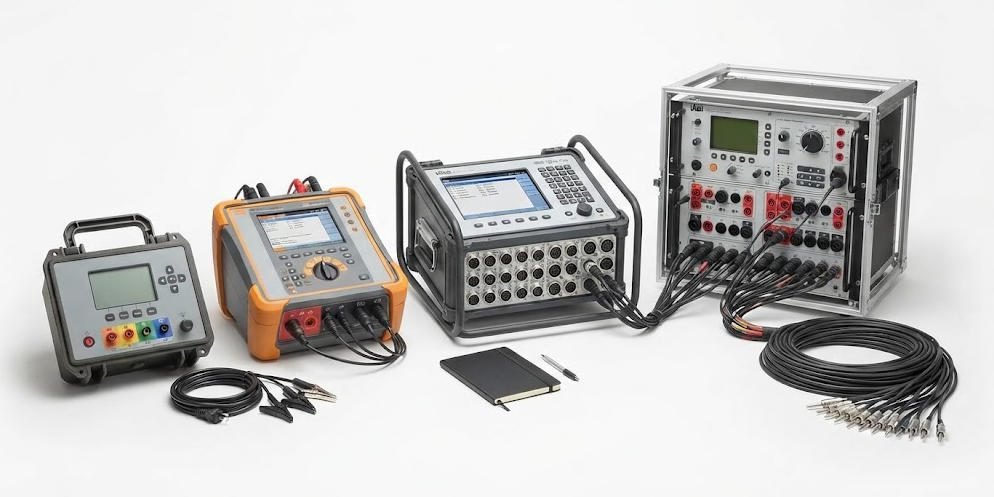
These categories overlap. A compact professional instrument with advanced functions may cost more than a basic system with a higher nominal channel count. Public equipment listings and supplier guides show substantial differences in advertised prices and configurations.
3. What Does the Quoted Price Include?
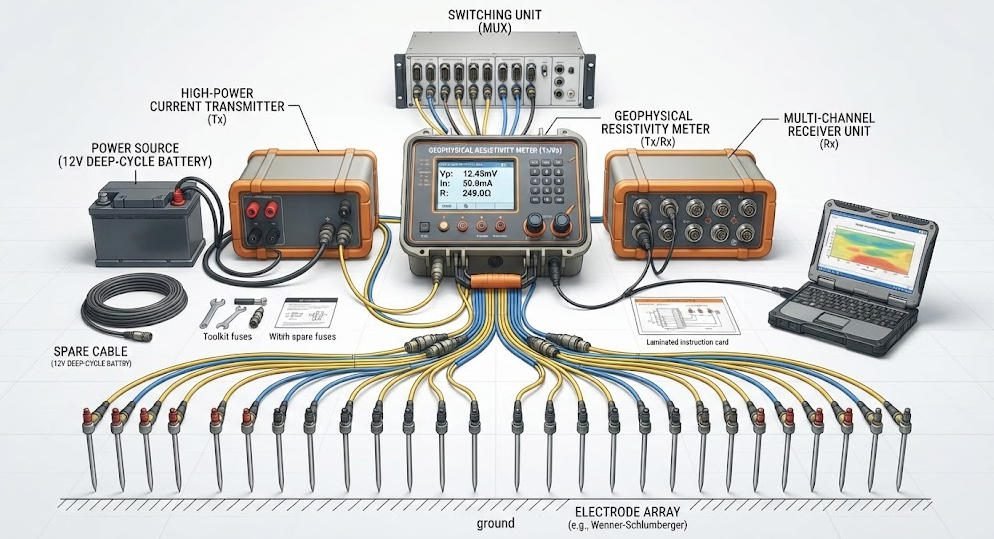
A low advertised price may cover only the core instrument. A complete field-ready system can require additional components.
Before comparing quotations, check whether the price includes:
- Resistivity meter or receiver.
- Current transmitter, where required.
- Electrode cables and electrodes.
- Electrode switching unit.
- Battery and charger.
- Acquisition software.
- Inversion software and licenses.
- Training, warranty, and technical support.
- Shipping, insurance, taxes, and import duties.
The most useful comparison is between systems that support the same survey objectives and include comparable accessories.
Ⅱ. What Determines the Price of a Resistivity Meter?
1. Measurement Method and System Architecture
The first price factor is the type of measurement the instrument supports.
A basic resistivity meter may perform simple electrical measurements. A field geophysical system may need controlled current injection, stable voltage measurements, multiple electrode configurations, and data recording.
An ERT system adds automated electrode switching and acquisition workflows. An integrated IP system must also measure polarization-related responses.
These differences affect hardware, software, development, and testing requirements.
2. Channel Capacity and Automation
Channel capacity affects how a system acquires measurements and supports survey workflows.
A single-channel instrument may measure one voltage response at a time. A multi-channel system can acquire multiple measurements within a suitable configuration.
However, channel count alone does not determine price or performance. Switching architecture, synchronization, measurement stability, software, and supported survey modes also matter.
For a project with frequent multi-electrode surveys, automation may reduce field time. For occasional measurements, a simpler configuration may be sufficient.
3. Transmitter Output and Measurement Performance
A resistivity system’s transmitter and receiver capabilities affect its suitability for different ground conditions.
Important specifications include:
- Maximum output current and voltage.
- Supported current waveforms.
- Measurement range and resolution.
- Input impedance.
- Noise performance and stability.
- Duty cycle and thermal management.
- Protection features and operating conditions.
Higher output capability may help in some high-resistance or deeper-investigation settings. It does not guarantee a specific investigation depth or better geological resolution.
4. IP Capability
An instrument designed for resistivity-only measurements may not support induced polarization.
IP-capable systems may require additional measurement modes, waveform control, timing accuracy, signal processing, and noise management.
The price difference depends on the specific architecture and included features. Buyers should verify whether the system supports time-domain IP, frequency-domain IP, or other required measurement modes.
5. Software and Data Processing
Software can be a significant part of the total purchase cost.
A complete workflow may involve acquisition software, data-quality tools, inversion software, and visualization tools.
Check whether the software is included, licensed permanently, subscription-based, or charged separately. Confirm supported file formats and compatibility with the processing tools used by your team.
Ⅲ. Resistivity Meter Price Comparison by System Type
1. Basic Instruments vs. Professional Field Systems
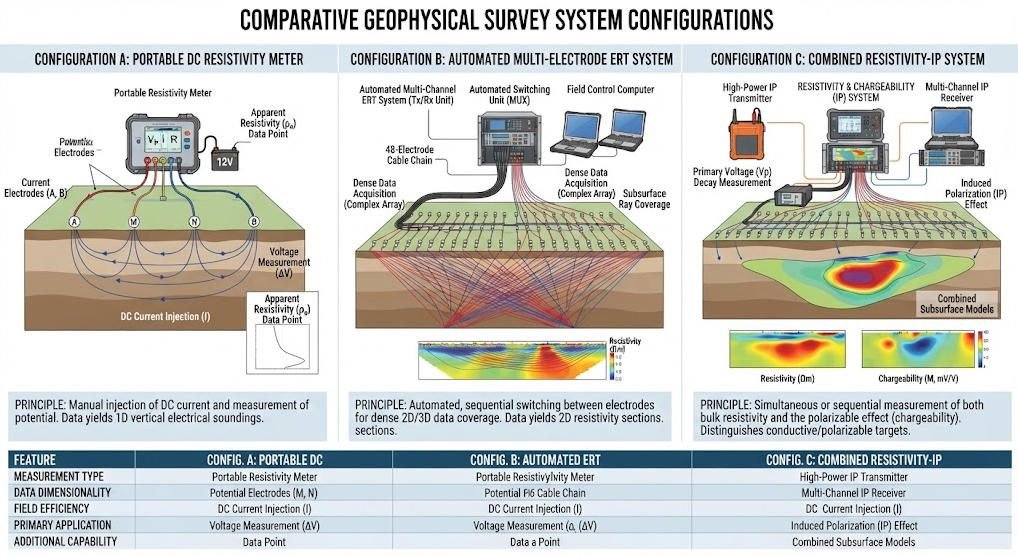
Basic instruments and professional geophysical systems may both measure electrical properties, but they serve different purposes.
| Feature | Basic Instrument | Professional Field System |
|---|---|---|
| Main purpose | Simple measurement or education | Subsurface geophysical investigation |
| Measurement workflow | Often manual or limited | Automated or programmable |
| Electrode configurations | Limited | Multiple supported configurations |
| Data management | Basic recording | Structured acquisition and export |
| ERT capability | Often unavailable | Available on suitable systems |
| IP capability | Usually limited or absent | Available on compatible systems |
| Support | Varies | May include training and technical support |
| Typical purchasing priority | Simplicity and affordability | Survey performance and workflow compatibility |
A low-cost instrument is not automatically unsuitable. It may be appropriate for a controlled laboratory task or basic field measurement. The key is matching its actual capabilities to the project.
2. ERT System vs. IP Resistivity System
ERT and IP systems overlap, but they are not interchangeable in every configuration.
| System Type | Main Function | Price Considerations |
|---|---|---|
| DC resistivity meter | Measures electrical resistivity responses | Current and voltage performance, measurement modes |
| Multi-electrode ERT system | Automates resistivity acquisition for imaging | Channel count, switching, cables, software |
| Resistivity + IP system | Measures resistivity and polarization responses | IP timing, waveform control, noise performance |
| High-power IP system | Supports demanding current-injection requirements | Output capability, power management, field configuration |
| Distributed acquisition system | Uses distributed measurement units or nodes | Synchronization, communication, coverage, system integration |
The correct comparison should be based on supported measurement methods, not just product names.
3. Example Budget Scenarios
The following examples are planning scenarios, not supplier quotations.
| Project Scenario | Possible Equipment Configuration | Budget Considerations |
|---|---|---|
| University teaching project | Basic meter, electrodes, simple data recording | Instrument, cables, and training |
| Small groundwater survey | Portable resistivity system with field accessories | Electrode layout, data recording, software |
| Regular 2D ERT work | Multi-electrode system with switching and inversion workflow | Cables, electrodes, automation, processing |
| Mineral exploration | Resistivity/IP system with suitable transmitter and receiver | IP capability, power requirements, survey scale |
| Large 3D survey | Multi-electrode or distributed acquisition system | Channel capacity, cabling, synchronization, software |
The final price should be based on the required system configuration and a written quotation.
Ⅳ. Additional Costs Beyond the Instrument Price
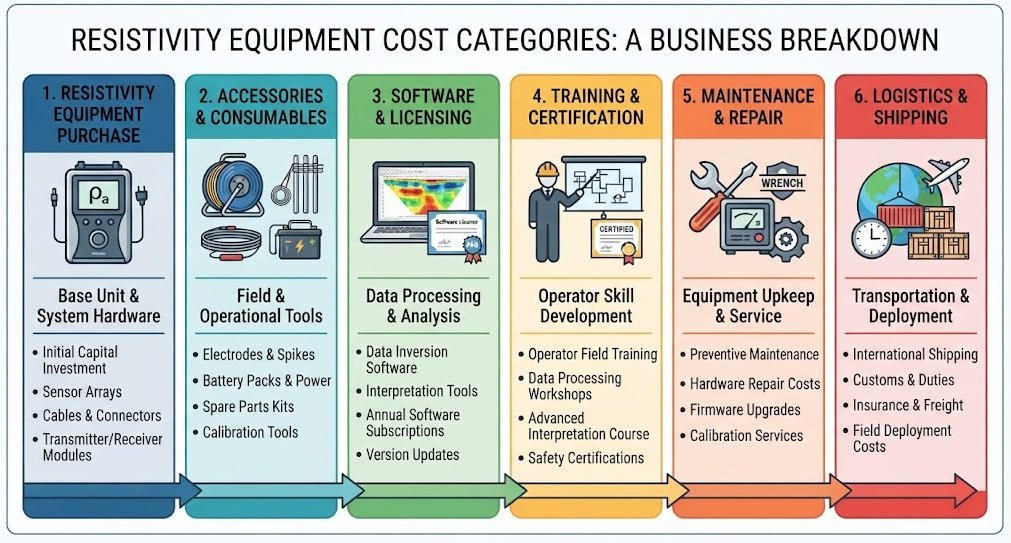
1. Accessories and Field Equipment
Accessories can materially affect the total budget.
A complete system may require electrodes, cables, connectors, battery packs, positioning equipment, and protective cases.
The number and length of cables depend on the survey layout. Large multi-electrode projects may require more extensive cable systems and additional switching components.
2. Software, Training, and Technical Support
Software licensing can be perpetual or subscription-based. Some suppliers include basic software, while advanced inversion or specialized analysis tools may require separate purchases.
Training can be important for teams unfamiliar with the equipment or measurement method.
Technical support, warranty coverage, repair arrangements, and spare-part availability also affect long-term costs.
3. Shipping, Taxes, and Import Costs
International purchases may involve:
- Freight and insurance.
- Customs clearance.
- Import duties and local taxes.
- Local certification requirements, where applicable.
- Bank transfer and currency-conversion fees.
- Local delivery and installation.
These costs vary by destination and shipment terms. Ask suppliers to state whether their quotation is EXW, FOB, CIF, DAP, or another Incoterm, and confirm which charges remain payable by the buyer.
4. Total Cost of Ownership (TCO)
Total Cost of Ownership (TCO) is the combined cost of purchasing, operating, maintaining, and supporting equipment over a defined period.
A practical TCO estimate includes:
TCO=Cpurchase+Caccessories+Csoftware+Coperation+Cmaintenance+Clogistics
Where each cost category should be estimated for the expected operating period.
| Cost Category | What to Include | Questions to Ask |
|---|---|---|
| Initial purchase | Instrument and standard configuration | What is included in the quoted price? |
| Accessories | Electrodes, cables, batteries, connectors | Are all required accessories included? |
| Software | Acquisition and inversion licenses | Is the license perpetual or recurring? |
| Maintenance | Repairs, calibration, replacement parts | What maintenance is recommended? |
| Training | Installation and operator instruction | Is training included? |
| Logistics | Shipping, taxes, insurance | Who pays each charge? |
| Downtime | Repair delays and backup arrangements | Is local service available? |
A higher purchase price may be justified if the system reduces operational bottlenecks or supports required survey methods. Conversely, an expensive system may be unnecessary for infrequent or limited measurements.
Ⅴ. Should You Rent or Buy a Resistivity Meter?
1. When Renting Makes Sense
Renting may be suitable when a project is short-term, the equipment is needed only occasionally, or the buyer wants to test a configuration before purchasing.
Rental agreements may include accessories and support, but the exact scope varies.
A rental quote should specify the rental period, equipment configuration, delivery, insurance, training, and responsibility for damage or repairs.
2. When Buying Makes Sense
Buying may be appropriate when an organization conducts regular surveys and needs reliable access to a specific instrument configuration.
Ownership provides more control over scheduling and equipment availability. It also creates responsibilities for maintenance, storage, calibration, and software management.
A purchase decision should consider expected annual field use, project revenue or internal value, and the full ownership cost.
3. Rental vs. Purchase Comparison
| Factor | Renting | Buying |
|---|---|---|
| Initial expenditure | Usually lower | Higher |
| Equipment availability | Depends on supplier schedule | Available when maintained and ready |
| Maintenance | Depends on contract | Owner’s responsibility |
| Configuration flexibility | Limited by rental inventory | Can be selected or customized |
| Long-term use | Can become costly | May be more suitable for recurring work |
| Short-term project | Often practical | May require unnecessary capital |
| Technical support | Contract-dependent | Warranty and service agreement-dependent |
There is no universal break-even point. Calculate it using actual rental rates, purchase quotations, expected usage, and maintenance costs.
Ⅵ. How to Choose the Right Resistivity Meter for Your Budget
1. Define the Survey Objective
Start with the question the survey must answer.
For example:
- Are you measuring soil resistivity for electrical grounding?
- Are you investigating groundwater or geological structures?
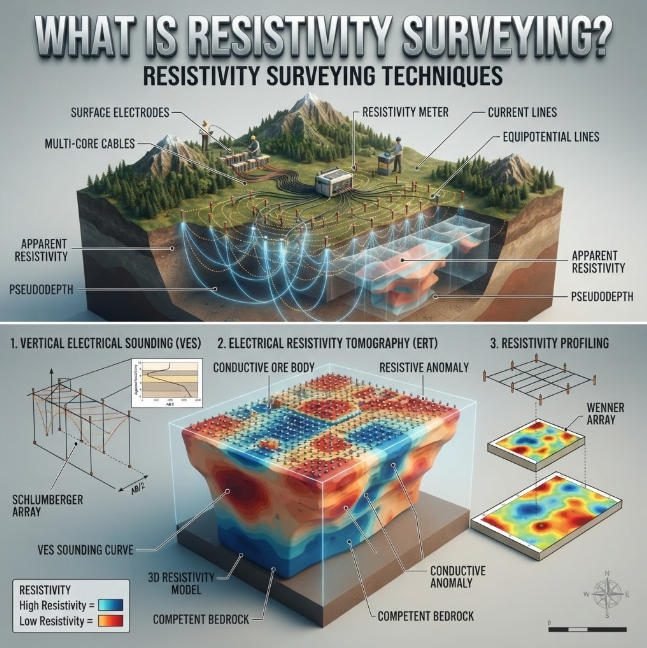
- Do you need 2D or 3D electrical resistivity imaging?
- Does the project require induced polarization?
- Is the work a one-time investigation or recurring commercial service?
These questions determine the appropriate instrument category.
2. Match Technical Requirements to the Budget
The selected system should meet the minimum technical requirements of the project.
| Requirement | What to Verify |
|---|---|
| Survey method | VES, profiling, ERT, or IP |
| Target depth | Sensitivity supported by survey geometry and system capabilities |
| Electrode layout | Supported arrays and switching configuration |
| Measurement quality | Accuracy, stability, noise, and repeatability |
| IP requirements | Time-domain or frequency-domain capability |
| Software | Data export and inversion compatibility |
| Field conditions | Power supply, environmental protection, and electrode contact |
| Support | Warranty, training, repairs, and spare parts |
Avoid choosing equipment based only on the lowest price or a single advertised specification.
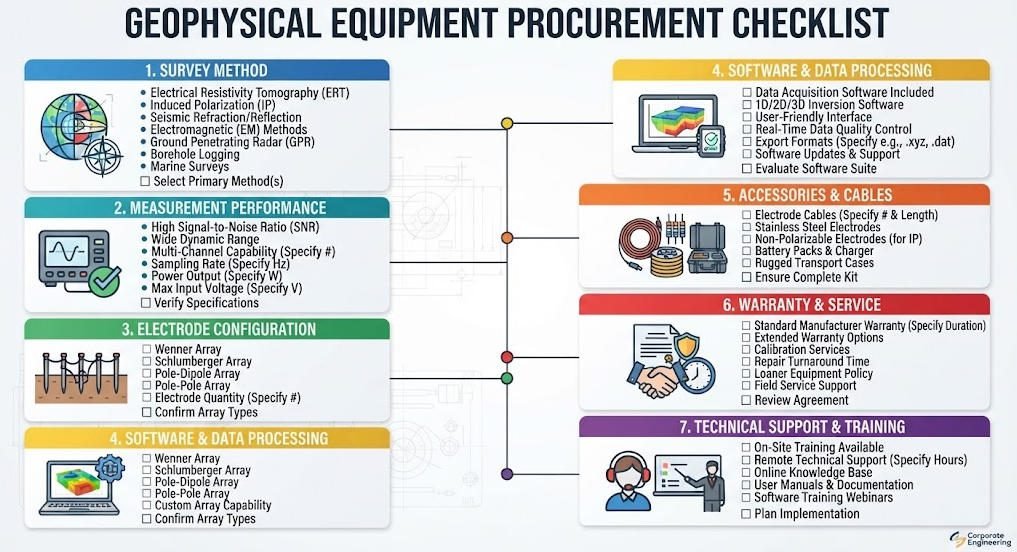
3. Compare Supplier Quotations Fairly
Request quotations using the same technical requirements and accessory list.
Ask each supplier to identify:
- Instrument model and configuration.
- Included transmitter, receiver, and switching components.
- Supported survey methods.
- Software and license terms.
- Standard accessories and optional items.
- Warranty and service conditions.
- Delivery schedule and shipping terms.
- Total delivered price.
A structured comparison reduces the risk of selecting a system that appears cheaper but lacks essential components.
Ⅶ. Where to Buy a Resistivity Meter
1. Direct from the Manufacturer
Buying directly from a manufacturer may provide access to technical specialists, configuration discussions, and product documentation.
Before placing an order, verify the manufacturer’s experience, specifications, warranty terms, and support arrangements.
2. Authorized Distributors
A distributor may provide local communication, training, delivery, and service.
Confirm whether the distributor is authorized and whether the warranty and service terms are recognized by the manufacturer.
3. Used and Refurbished Equipment
Used equipment may reduce the initial purchase cost, but condition and compatibility require careful inspection.
Check:
- Calibration and repair history.
- Battery condition.
- Cable and connector integrity.
- Electrode switching reliability.
- Software license transferability.
- Availability of spare parts.
- Compatibility with current operating systems and data formats.
Request a demonstration or acceptance test before purchase when possible.
Ⅷ. Geotech Resistivity and IP Equipment
Geotech offers electrical exploration equipment for resistivity and induced polarization applications.
For project-specific pricing, buyers should identify the required survey method, measurement configuration, transmitter and receiver needs, accessories, and software requirements before requesting a quotation.
Related product and technical resources:
- High Power IP System
- High Power IP System — Related Configuration
- WDA-1 DC Meter
- WGMD-9 Distributed System
- What Are Resistivity Meters?
- Electrical Imaging: ERT and VES
- Induced Polarization Method Guide
Ⅸ. Conclusion
The price of a resistivity meter depends on its measurement method, system architecture, performance requirements, and included accessories.
Basic instruments may meet simple measurement needs, while professional ERT and IP systems require more advanced acquisition, switching, and processing capabilities.
The most reliable purchasing process starts with the survey objective, establishes a technical specification, compares complete quotations, and evaluates total cost of ownership.
The right resistivity meter is the system that meets the project’s measurement requirements and operating conditions within a realistic budget—not necessarily the cheapest or most expensive option.
Related Articles
| Title | Core Content | URL |
|---|---|---|
| What Are Resistivity Meters? | Resistivity meter principles, functions, and applications | https://geotechcn.net/service/what-are-resistivity-meters/ |
| High Power IP System | High-power induced polarization and electrical exploration equipment | https://geotechcn.net/products/electrical-instrument/high-power-ip-system/ |
| High Power IP System — Related Configuration | Related high-power electrical exploration system configuration | https://geotechcn.net/products/electrical-instrument/high-power-ip-system-2/ |
| WDA-1 DC Meter | DC electrical measurement and resistivity-related applications | https://geotechcn.net/products/electrical-instrument/wda-1-dc-meter/ |
| WGMD-9 Distributed System | Distributed electrical exploration system | https://geotechcn.net/products/electrical-instrument/wgmd-9-distributed-system/ |
| Electrical Imaging: ERT and VES | Electrical resistivity imaging and sounding methods | https://geotechcn.net/service/electrical-imaging-ert-ves/ |
| Induced Polarization Method Guide | IP principles, applications, and survey methods | https://geotechcn.net/service/induced-polarization-ip/ |
| Geophysical Surveying Explained | Overview of geophysical methods and subsurface investigation | https://geotechcn.net/service/geophysical-surveying-explained/ |
| Geophysical Methods Demystified | Overview of geophysical exploration methods and applications | https://geotechcn.net/service/geophysical-methods-demystified/ |
Reference Sources
| Title | Core Content | URL |
|---|---|---|
| Development and Validation of a Low-Cost Direct Current Resistivity Meter — Geophysics | Research on the design, cost, and field validation of a low-cost DC resistivity instrument | https://pubs.geoscienceworld.org/seg/geophysics/article/87/1/WA1/609616/Development-and-validation-of-a-low-cost-direct |
| Electrical Resistivity — U.S. Environmental Protection Agency | Resistivity principles, electrode configurations, and survey applications | https://www.epa.gov/environmental-geophysics/electrical-resistivity |
| Induced Polarization and Complex Resistivity — U.S. Environmental Protection Agency | IP measurement principles and applications | https://www.epa.gov/environmental-geophysics/induced-polarization-ip-and-complex-resistivity |
| ASTM International | Technical standards and guidance for engineering and geophysical measurements | https://www.astm.org/ |
| IEEE Standards Association | Electrical engineering standards and technical references | https://standards.ieee.org/ |
Reference note: Published equipment prices should be treated as dated examples. Research on low-cost instruments can help explain how system architecture affects cost, but it does not establish the price of a commercial professional system.
FAQ
Q1. How much does a resistivity meter cost?
A resistivity meter may cost from a few hundred dollars for a basic instrument to tens of thousands of dollars for a professional ERT or IP system. The final price depends on measurement capability, automation, accessories, and software. Buyers should compare complete configurations rather than relying on the instrument’s headline price alone.
Q2. What is the difference between a basic resistivity meter and an ERT system?
A basic resistivity meter typically performs simpler electrical measurements, while an ERT system automates multiple electrode configurations to collect data for subsurface imaging. ERT systems may require switching equipment, multi-electrode cables, and inversion software. The appropriate choice depends on whether the project needs basic measurements or spatial resistivity models.
Q3. Does an IP-capable resistivity meter cost more?
An IP-capable system may cost more because it needs additional measurement functions, timing control, signal processing, and noise management. The actual price difference depends on the system architecture and included features. Buyers should verify whether the equipment supports time-domain IP, frequency-domain IP, or both before comparing quotations.
Q4. What additional costs should I consider when buying a resistivity meter?
Beyond the instrument, budget for electrodes, cables, batteries, software, training, shipping, taxes, and maintenance. Some systems include essential accessories, while others quote them separately. Request an itemized quotation and confirm the warranty, license terms, delivery conditions, and service arrangements to estimate the complete ownership cost.
Q5. Is renting a resistivity meter cheaper than buying one?
Renting can be practical for short-term or occasional projects because it reduces the initial capital requirement. Buying may be suitable for organizations that conduct frequent surveys and need regular access to equipment. Compare actual rental fees, purchase costs, expected usage, maintenance, and support to determine the more economical option.